In the previous blog, I discussed very briefly how
spending some time in the company of the same individual or small group of
animals on separate occasions has allowed me to explore their lives more
intimately and meaningfully through photography. This is one strategy that I
relish whenever I stumble across such an infrequent and special instance. I
indicated too that spending time repeatedly in the same small locality on separate
trips has allowed me to maximise the odds of capturing the sense of place much more
intensely. Repeated visits have not only allowed me to broaden my understanding,
appreciation and feel for a locale; recurring outings to the same area also spur
me on to work harder at capturing all features of a place photographically.
In a significant way, a locality brings to
light its magnificence, beauty and meaning to me (as a photographer) only once
I have taken several photographs during an initial visit, I have had time thereafter
to reflect on these images, and then I have had an occasion to revisit the region
once more. This allows me to compare my first photographic efforts to the
actual place and to my experiences of it during this subsequent opportunity. Moreover,
on succeeding visits, I inevitably discover new, previously unobserved features
of the place, different conditions of lighting, my different moods will evoke
different responses each time around, and the place itself too will have altered
in many particulars. Never has a locality confronted me with congruent
combinations of visual delights or photographic challenges as on any previous
occasion.
Any destination, no matter how often I have
visited it, will always provide unique experiences if I remain receptive to its
sense of place and I am willing to pursue it. At a very young age I learnt that
having encountered a particular place and photographed it, does not equate with
comprehension, appreciation and complete discovery of a locale.
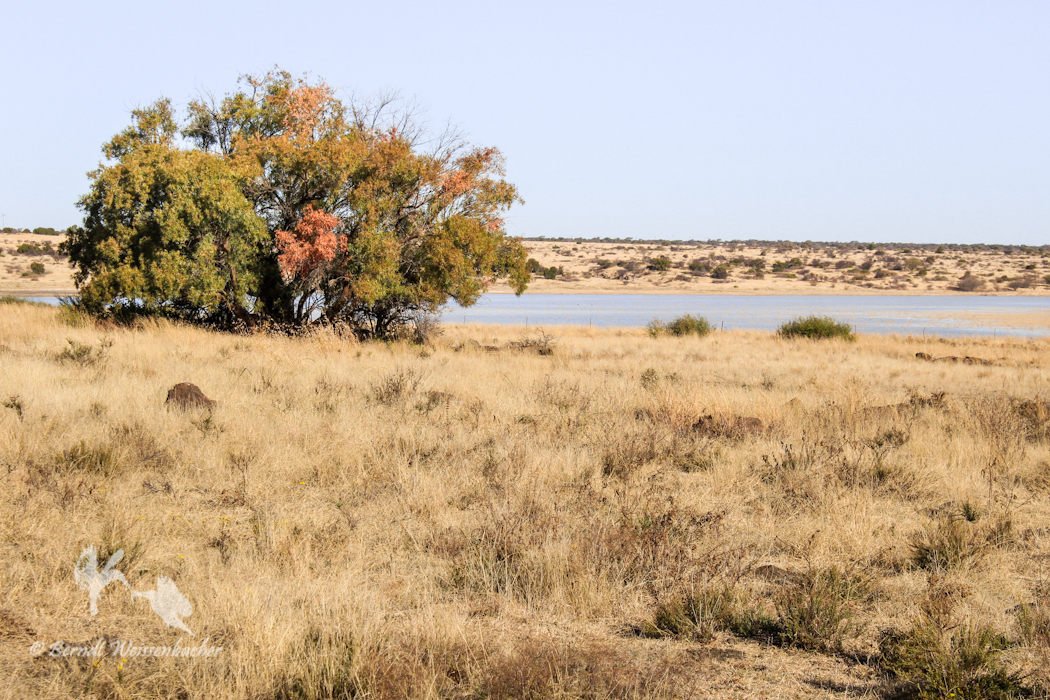
I have written previously about Palmietpan, a
small sheep and cattle farm in the south-western Free State Province of South
Africa. As with all agricultural landscapes, fences, tracks and roads crisscross
Palmietpan too, and the farm is peppered with cribs, windmills, kraals and outbuildings. Worse still, Palmietpan
is situated on the outskirts of the town of Hertzogville/Malebogo – maize
silos, electricity pylons and telephone lines dominate the skyline. The general
landscape of Palmietpan is monotonous; flat grassland covers most of the farm,
with an occasional clump of several Acacia
thorn-tree species, Buffalo-Thorn Jujube, Karee and Wild Asparagus at
watering-points. A small, shallow dam and a large pan are present as open
expanses of cracked clay for most of the year – in summers with good rainfall,
they do hold some shallow water. An isolated portion of the farm is covered by
open bushveld, but I have had only very few opportunities to spend time there
with a camera.
Family commitments have always determined the
times of my visits, most often during the end of summer or in the middle of
winter. In addition, many visits have coincided with times of severe drought. Of
all the places I visit regularly, Palmietpan has set the greatest challenge
photographically. Apart from a brief stopover of a sporadic vagrant (a Kudu or
a Warthog, for example), the farm is devoid of large game. For a photographer
interested in the environment and its inhabitants, first impressions of Palmietpan
are that this farm is unphotogenic in
extremis.
Over the past decade and a half, I have
wrestled with Palmietpan. Initially I would gladly have swapped localities with
almost any other environment; nevertheless, I had no choice and had to accept
the challenge posed by this farm, an agrarian area that seemingly would not
bring to light any fine photographs. Palmietpan is a place that humbles the
photographer – every composition, every image has to be discovered through hard
work. Here, photographs do not happen, compositions do not await disclosure by
a photographer’s merely cursory glance.
Yet, as I have discovered (and I am still
discovering fifteen years on), Palmietpan is a magical place of hidden beauty
and exciting encounters. The most obvious photographic gems are the various
patches of different grasses on the grassland expanses. The seasonal changes in
the interaction between the light and the grasses – each species with its own
specific inflorescence, height, thickness of culms and shape, length and
arrangement of leaves – is astonishing. Hidden between the grasses are the
numerous shrubs and herbs, each with different flowers in summer. These
colourful gems are usually small – the tall grasses conceal them – so that only
prolonged hikes through dense grassland can uncover them.
The bushes and trees also display beautiful
flowers for a short while in summer, but they retain throughout the year their individual
growth-forms and distinctive plant parts, including cladodes (instead of leaves),
hooks, prickles or thorns, for example. Just as every part of a nude body can
be photographed, so too every part of a plant reveals beauty.
While grasslands hide the splendour of the
insect and spider life extremely well, especially in dryer months, the
Harvester Ants are busy throughout the seasons. When water is present in the
small dam, colourful dragonflies and damselflies zing through the air or wait
patiently on grass stalks or branches of shrubs for passing prey. The seemingly
abandoned grasslands also hide the small mammal inhabitants, the rodents and
small carnivores. Very patiently, they have taught me their individual habits and
they have revealed their favourite seasonal haunts.
After a long apprenticeship, I can now find and
approach Four-striped Mice, South African Ground Squirrels and Yellow Mongooses
whenever I feel the need for a good chuckle at their skittish and secretive
behaviour. I have learnt, too, exactly where different species of grassland and
bushveld birds will find a beak-full of water, even during droughts, and which
water birds I can expect to encounter in the wetter summers.
By working away at first discovering, then
learning about Palmietpan, over many visits to this one small place, I have been
able to capture at least some of the essence of the grasslands, bushveld, dam, pan
and the residents of this most wonderful domain. There is no need to rush from
photogenic locality to the next – patience, observation and the ceaseless
exploration of even the most unpromising environment over time will yield
successful photographic compositions.
The sense of personal achievement as a
photographer is boosted by having to work hard at the fundamentals of
photography, searching for compositions rather than being confronted without
effort by an obvious landscape that is then photographed but often left
uncharted. I learned very early on in my photographic journey that restriction
to access of a discernibly photogenic destination in no way diminishes my
photographic passion or chances of capturing unique images. I simply need to
work harder and become receptive to the sense of place that surrounds me,
wherever I may find myself.
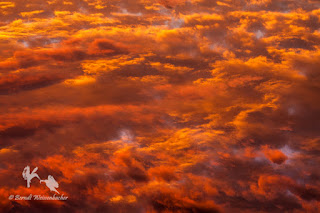
Moreover, Palmietpan even provides ‘landscape
photography’ regularly. While the ground below baulks against composition as a
dynamic, satisfactory landscape image, the high vaulted sky above provides
cloudscapes, which, like all landscapes, challenge any photographer to find a
composition – not of an actual place on Earth, but a haven for cloud princesses,
giants, ogres, gremlins and imps who will show their residences and castles to
any earthbound explorer of the endless vista of clouds, again-and-again,
visit-after-visit.
Every landscape tells its own story; every
landscape discloses an ancient history of how it came to be. A history of
deposition and erosion, formation and shaping, degradation and re-moulding. A
story of the geological processes and the weather that carved and shaped it. The
story tells too of recent modifications to those parts of the landscape that
are less resistant, more accepting of alteration; at the same time, other parts
of the landscape display an unyielding antagonism to change. Whether a
landscape’s story is gentle or more violent depends entirely on the specific landscape
that is being observed and of its own unique geology and the much more recent
history of its occupation (or not) by human beings.
Is there a single word that expresses “a
feeling of place, a sense of place”? The word ‘landscape’ seems wholly
inadequate and very restrictive too. In some sense, a landscape describes the
lie of the land, the topography of a place. Once captured in an image, a
photograph, a sketch or a painting, a landscape acts as a portrait of an area.
Like portraits of living beings, the ‘landscape’ we peruse also hints at the character,
the unique qualities of a select portion of scenery that enticed the visual
artist to record it. At the same time, the ‘landscape’, the portrait of a place,
also reveals the personality and sentiment of the visual artist herself; it
reveals the emotional response by the artist to a specific location.
Ever since the start of our relationship, I
have been accompanying my wife, Jacqui, on three or four annual trips to an old
family farm in the western Free State Province of South Africa. In this part of
the interior of the country, the topsoil is sparse and the ground beneath is
gravelly at best, if not outright rocky. Unlike the vast, sandy,
maize-producing plains to the north-east and east, this part of the Free State
is sheep and cattle country. Here the horizon is flat and very distant, broken
only by an occasional low ridge or kopje. The sky always dominates the
landscape beneath it. On a clear winter’s day, the flat land is overarched by an
immensity of deep-blue air; when moisture fills the air during the summer
months and thunderstorms construct themselves, the land lies still and silent,
as though cowed by the towering cloudscapes above it.
Along the southern boundary of the family farm
lies a sizeable pan – a completely level expanse of salt-encrusted, dark-grey
clay. Along its perimeter grow sedges – sometimes (falsely) referred to as palmiet in old Afrikaans. From these two
features the farm derives its name: Palmietpan.
In the seventeen years that I have been visiting the family farm, I have never
seen the pan filled with water.
On our most recent trip at the end of July
2020, as we approached the farm during the late afternoon, the pan lay before
us, glistening. Black-winged Stilts, various species of ducks (including South
African Shelduck and Egyptian Geese), Kittlitz's
and Three-banded Plovers, and even a small
group of Lesser Flamingos were feeding in different locations and at different
depths of water along the shoreline of the pan.
The pan forms a dimple in the otherwise flat countryside
of this part of the Free State province. The rim of the pan rises in a very
gentle slope from the floor of the pan to the height of the grasslands and
thorny scrublands some 100 to 150 metres higher up. Now, at the height of
winter, the slope all around the pan was covered in various tall, dry grasses
and low thorn scrub, with stunted Sweet Thorn (Acacia (Vachellia) karroo), Buffalo-Thorn Jujube (Ziziphus mucronata), honeythorns (Lycium spp.)
and Wild Asparagus (Asparagus laricinus)
predominating. On the farm property, on the north-eastern shoreline of the pan,
the rim incorporates a small, fairly narrow level step on which stand two
groves of very large, ancient Karee (Searsia
lancea) trees, now accompanied by scrubby Ziziphus mucronata bushes.
On this ‘platform’, in the immediate vicinity
of these old trees, particularly on sheets of rock exposed by rain and wind,
countless San stone artefacts lie scattered about fully exposed. Cutting
implements, scraping implements and the occasional arrow tip can be found here.
Close-by, a large area of ground is covered in chips and flakes of stone
knapped off fist-sized rocks unknown eternities ago.
This intriguing area has never been studied in
detail. Apart from identifying the stone tools as “of San origin”, linked with a comment of “we have sufficient examples of such stone tools”, those South
African universities that have been approached with a select sample of the
stone implements have not taken any further interest. Yet the landscape of Palmietpan seems to indicate a much more
fascinating tale.
I am not an archaeologist. Any thoughts I
express and any claims I may make in this short blog are not grounded in
factual evidence. Yet, Palmietpan conveys
a kind of ‘sense of place’; it hints at a significance to the San
hunter-gatherers in a bygone era. To me, at least, the size of the pan itself,
the sheer volume and variety of rock chips and stone tools found in this very small
area, and the location of the finds on the only level shelf overlooking the entire
pan seem notable. Together, they suggest a far greater import of this site to
the aboriginal inhabitants than a mere happenstance locality fit only
for short-lived occupation by a few bands of San at some unknown era in the
past.
The pan is large and, as this winter has
proved, it will hold water for months after the last rains have fallen at the
end of summer. Alone this possible source of water (albeit unpredictable and
seasonal) in a region that experiences long, dry winters would make Palmietpan an area of consequence. The
amount of stone chips and flakes that can be found here speak of a site at
which the working of stone and the crafting of stone tools took place over a
significantly long period of time – to leave such copious evidence behind, work
must have taken place here over at least several seasons. Add to this the
countless implements found here that were never finished and were simply thrown
aside. For a while at least, Palmietpan
must have formed part of a stone-crafting workspace. And then the ledge itself
adds a definite sense of significance. The view from this only piece of level
ground along the rim of the pan covers the entire perimeter of the pan and its
surrounding sparse, scrubby thorn-veld. Any animal, any human, moving about in
this flat land would have been noticed by a keen observer occupying the level
shelf.
For many days, I have searched the immediate
vicinity of the pan relentlessly for a possible source of the rock material
used in the knapping process to make these stone implements. A very thin layer
of dark-grey, clay-like rock is exposed near the platform with the tree groves.
This layer is overlain by several metres of gravel and soil. Yet the incessant
excavations of golden moles and the deep tunnel systems mined out of the hard,
overlying soil by ground squirrels do hint at a possible source, deep beneath
the topsoil, of rock similar to that used long ago by the San for the manufacture
of the stone tools.
At Palmietpan,
the landscape is being churned over by these fossorial and burrow-excavating
small mammals. Chunks of calcrete and other rock material, not found at the
surface, are heaved out of their tunnels by the ground squirrel families. The mounds
of the golden moles are littered with stone fragments of precisely the type of
rock worked by the San long ago. Beneath the topsoil there must lie further
evidence of an occupation, albeit seasonal, of this landscape long ago by a
significant number of San artisans.
For its inhabitants, particularly so for human
beings, different landscapes hold different significances. More than that, the
same landscape acquires diverse meanings for different individuals too.
Different individuals will each react in a singular and personal way to the
same landscape. (Each individual human probably can and does envisage or imagine
her or his beloved landscape. Often this landscape is part of a precious memory
from past travels; sometimes (I suspect in humans other than myself too), this
‘landscape’ is purely imaginary. Each of us probably conveys in the mind her or
his own idyllic landscape.)
A (particular) landscape is often idealised
when it is depicted or described. As humans, our penchant for romanticism often
imbues a landscape with meaning; it attributes to a landscape a personification
and a role that reflects our deepest hopes and desires. The significance of a
landscape to us as individuals, families, communities or even nations is often entwined
with personal or historical episodes that have shaped our lives: a locality, a
landscape, is intimately associated with spaces of personal crisis or of
battle, places of hardship or places of plenty, scenes of loss or of gain. We
look at landscapes through our own or collective spectacles. We depict our
chosen landscapes with these cultural stimuli in mind, so that our view of the
land is always emotionally charged and highly subjective. Moreover, for us, the
observers, the landscape itself takes on an individuality, a nature that,
together with our cultural or private accretions we append to a place, gives
rise to an endless and fascinating mythopoeia of landscape.
So too it is with Palmietpan: the water of the pan, its shorelines of mud and soil,
its gentle slopes of thorn-scrub and tall grasses, and its inhabitants over
many aeons of time. The landscape of Palmietpan
speaks of an oasis, a significant place in the otherwise water-scarce landscape
of the western Free State.
On one of the smaller expanses of exposed rock
on the shelf with the two groves of Karee lie the desiccated remains of a
long-dead Cattle Egret. This tableau of rock, bone and feathers serves as a
reminder to any conscious observer that possession of a landscape and its
occupation too are transient indeed. Landscapes seem much longer-lived, and
yet, like organisms, they change over time, they age and mature, not only in
their geological features, but also in their significances, in their meanings
to the current and past inhabitants of the landscapes, in their ‘sense of
place’.