Showing posts with label grasslands. Show all posts

Sunday, 6 December 2020

ON PHOTOGRAPHY: Maximising the Odds of Photographic Expression – 2. A Farm Called Palmietpan


In the previous blog, I discussed very briefly how spending some time in the company of the same individual or small group of animals on separate occasions has allowed me to explore their lives more intimately and meaningfully through photography. This is one strategy that I relish whenever I stumble across such an infrequent and special instance. I indicated too that spending time repeatedly in the same small locality on separate trips has allowed me to maximise the odds of capturing the sense of place much more intensely. Repeated visits have not only allowed me to broaden my understanding, appreciation and feel for a locale; recurring outings to the same area also spur me on to work harder at capturing all features of a place photographically.


This image is Copyrighted © Berndt Weissenbacher/BeKaHaWe. If you like it, you may share this image as presented here under a Creative Commons Attribution-NonCommercial-NoDerivs 3.0 License (CC BY-NC-ND 3.0). NO OTHER USE OF THIS IMAGE is permitted without the express consent of the photographer.


In a significant way, a locality brings to light its magnificence, beauty and meaning to me (as a photographer) only once I have taken several photographs during an initial visit, I have had time thereafter to reflect on these images, and then I have had an occasion to revisit the region once more. This allows me to compare my first photographic efforts to the actual place and to my experiences of it during this subsequent opportunity. Moreover, on succeeding visits, I inevitably discover new, previously unobserved features of the place, different conditions of lighting, my different moods will evoke different responses each time around, and the place itself too will have altered in many particulars. Never has a locality confronted me with congruent combinations of visual delights or photographic challenges as on any previous occasion. 


This image is Copyrighted © Berndt Weissenbacher/BeKaHaWe. If you like it, you may share this image as presented here under a Creative Commons Attribution-NonCommercial-NoDerivs 3.0 License (CC BY-NC-ND 3.0). NO OTHER USE OF THIS IMAGE is permitted without the express consent of the photographer.


Any destination, no matter how often I have visited it, will always provide unique experiences if I remain receptive to its sense of place and I am willing to pursue it. At a very young age I learnt that having encountered a particular place and photographed it, does not equate with comprehension, appreciation and complete discovery of a locale.


This image is Copyrighted © Berndt Weissenbacher/BeKaHaWe. If you like it, you may share this image as presented here under a Creative Commons Attribution-NonCommercial-NoDerivs 3.0 License (CC BY-NC-ND 3.0). NO OTHER USE OF THIS IMAGE is permitted without the express consent of the photographer.


I have written previously about Palmietpan, a small sheep and cattle farm in the south-western Free State Province of South Africa. As with all agricultural landscapes, fences, tracks and roads crisscross Palmietpan too, and the farm is peppered with cribs, windmills, kraals and outbuildings. Worse still, Palmietpan is situated on the outskirts of the town of Hertzogville/Malebogo – maize silos, electricity pylons and telephone lines dominate the skyline. The general landscape of Palmietpan is monotonous; flat grassland covers most of the farm, with an occasional clump of several Acacia thorn-tree species, Buffalo-Thorn Jujube, Karee and Wild Asparagus at watering-points. A small, shallow dam and a large pan are present as open expanses of cracked clay for most of the year – in summers with good rainfall, they do hold some shallow water. An isolated portion of the farm is covered by open bushveld, but I have had only very few opportunities to spend time there with a camera.


This image is Copyrighted © Berndt Weissenbacher/BeKaHaWe. If you like it, you may share this image as presented here under a Creative Commons Attribution-NonCommercial-NoDerivs 3.0 License (CC BY-NC-ND 3.0). NO OTHER USE OF THIS IMAGE is permitted without the express consent of the photographer.


Family commitments have always determined the times of my visits, most often during the end of summer or in the middle of winter. In addition, many visits have coincided with times of severe drought. Of all the places I visit regularly, Palmietpan has set the greatest challenge photographically. Apart from a brief stopover of a sporadic vagrant (a Kudu or a Warthog, for example), the farm is devoid of large game. For a photographer interested in the environment and its inhabitants, first impressions of Palmietpan are that this farm is unphotogenic in extremis.


This image is Copyrighted © Berndt Weissenbacher/BeKaHaWe. If you like it, you may share this image as presented here under a Creative Commons Attribution-NonCommercial-NoDerivs 3.0 License (CC BY-NC-ND 3.0). NO OTHER USE OF THIS IMAGE is permitted without the express consent of the photographer.


Over the past decade and a half, I have wrestled with Palmietpan. Initially I would gladly have swapped localities with almost any other environment; nevertheless, I had no choice and had to accept the challenge posed by this farm, an agrarian area that seemingly would not bring to light any fine photographs. Palmietpan is a place that humbles the photographer – every composition, every image has to be discovered through hard work. Here, photographs do not happen, compositions do not await disclosure by a photographer’s merely cursory glance.


This image is Copyrighted © Berndt Weissenbacher/BeKaHaWe. If you like it, you may share this image as presented here under a Creative Commons Attribution-NonCommercial-NoDerivs 3.0 License (CC BY-NC-ND 3.0). NO OTHER USE OF THIS IMAGE is permitted without the express consent of the photographer.


Yet, as I have discovered (and I am still discovering fifteen years on), Palmietpan is a magical place of hidden beauty and exciting encounters. The most obvious photographic gems are the various patches of different grasses on the grassland expanses. The seasonal changes in the interaction between the light and the grasses – each species with its own specific inflorescence, height, thickness of culms and shape, length and arrangement of leaves – is astonishing. Hidden between the grasses are the numerous shrubs and herbs, each with different flowers in summer. These colourful gems are usually small – the tall grasses conceal them – so that only prolonged hikes through dense grassland can uncover them.


This image is Copyrighted © Berndt Weissenbacher/BeKaHaWe. If you like it, you may share this image as presented here under a Creative Commons Attribution-NonCommercial-NoDerivs 3.0 License (CC BY-NC-ND 3.0). NO OTHER USE OF THIS IMAGE is permitted without the express consent of the photographer.


The bushes and trees also display beautiful flowers for a short while in summer, but they retain throughout the year their individual growth-forms and distinctive plant parts, including cladodes (instead of leaves), hooks, prickles or thorns, for example. Just as every part of a nude body can be photographed, so too every part of a plant reveals beauty.


This image is Copyrighted © Berndt Weissenbacher/BeKaHaWe. If you like it, you may share this image as presented here under a Creative Commons Attribution-NonCommercial-NoDerivs 3.0 License (CC BY-NC-ND 3.0). NO OTHER USE OF THIS IMAGE is permitted without the express consent of the photographer.


While grasslands hide the splendour of the insect and spider life extremely well, especially in dryer months, the Harvester Ants are busy throughout the seasons. When water is present in the small dam, colourful dragonflies and damselflies zing through the air or wait patiently on grass stalks or branches of shrubs for passing prey. The seemingly abandoned grasslands also hide the small mammal inhabitants, the rodents and small carnivores. Very patiently, they have taught me their individual habits and they have revealed their favourite seasonal haunts.


This image is Copyrighted © Berndt Weissenbacher/BeKaHaWe. If you like it, you may share this image as presented here under a Creative Commons Attribution-NonCommercial-NoDerivs 3.0 License (CC BY-NC-ND 3.0). NO OTHER USE OF THIS IMAGE is permitted without the express consent of the photographer.


After a long apprenticeship, I can now find and approach Four-striped Mice, South African Ground Squirrels and Yellow Mongooses whenever I feel the need for a good chuckle at their skittish and secretive behaviour. I have learnt, too, exactly where different species of grassland and bushveld birds will find a beak-full of water, even during droughts, and which water birds I can expect to encounter in the wetter summers.


This image is Copyrighted © Berndt Weissenbacher/BeKaHaWe. If you like it, you may share this image as presented here under a Creative Commons Attribution-NonCommercial-NoDerivs 3.0 License (CC BY-NC-ND 3.0). NO OTHER USE OF THIS IMAGE is permitted without the express consent of the photographer.


By working away at first discovering, then learning about Palmietpan, over many visits to this one small place, I have been able to capture at least some of the essence of the grasslands, bushveld, dam, pan and the residents of this most wonderful domain. There is no need to rush from photogenic locality to the next – patience, observation and the ceaseless exploration of even the most unpromising environment over time will yield successful photographic compositions.


This image is Copyrighted © Berndt Weissenbacher/BeKaHaWe. If you like it, you may share this image as presented here under a Creative Commons Attribution-NonCommercial-NoDerivs 3.0 License (CC BY-NC-ND 3.0). NO OTHER USE OF THIS IMAGE is permitted without the express consent of the photographer.


The sense of personal achievement as a photographer is boosted by having to work hard at the fundamentals of photography, searching for compositions rather than being confronted without effort by an obvious landscape that is then photographed but often left uncharted. I learned very early on in my photographic journey that restriction to access of a discernibly photogenic destination in no way diminishes my photographic passion or chances of capturing unique images. I simply need to work harder and become receptive to the sense of place that surrounds me, wherever I may find myself.


This image is Copyrighted © Berndt Weissenbacher/BeKaHaWe. If you like it, you may share this image as presented here under a Creative Commons Attribution-NonCommercial-NoDerivs 3.0 License (CC BY-NC-ND 3.0). NO OTHER USE OF THIS IMAGE is permitted without the express consent of the photographer.


Moreover, Palmietpan even provides ‘landscape photography’ regularly. While the ground below baulks against composition as a dynamic, satisfactory landscape image, the high vaulted sky above provides cloudscapes, which, like all landscapes, challenge any photographer to find a composition – not of an actual place on Earth, but a haven for cloud princesses, giants, ogres, gremlins and imps who will show their residences and castles to any earthbound explorer of the endless vista of clouds, again-and-again, visit-after-visit.


This image is Copyrighted © Berndt Weissenbacher/BeKaHaWe. If you like it, you may share this image as presented here under a Creative Commons Attribution-NonCommercial-NoDerivs 3.0 License (CC BY-NC-ND 3.0). NO OTHER USE OF THIS IMAGE is permitted without the express consent of the photographer.


Tuesday, 14 July 2020

A GRASS MENAGERIE: II - The Inhabitants of the Grasslands


In essence, the smaller denizens of the grasslands (including the myriad of insects inhabiting this biome) live in a forest-like environment – not under a canopy of leaves and between tree trunks, but rather between the culms and the inflorescences of the taller grasses. Their environment is dense and provides for ample opportunities either to shelter or to escape from predators. 


This image is Copyrighted © Berndt Weissenbacher/BeKaHaWe. If you like it, you may share this image as presented here under a Creative Commons Attribution-NonCommercial-NoDerivs 3.0 License (CC BY-NC-ND 3.0). NO OTHER USE OF THIS IMAGE is permitted without the express consent of the photographer.


Moreover, these smaller organisms, experience subtle stratification of the environmental factors (such as light intensity, temperature and humidity) from ground level upwards to the top layer of the grasses. These littlies can move up and down in their environment to modify, albeit very slightly, the influence on their tiny bodies of a few environmental factors. For example, any small motile animals living in the grasslands can escape the heat of a summer’s day by moving down to the shaded ground level; they can escape desiccating winds, again by sheltering at the bases of the grasses. Despite these advantages, the differences between day and night are significant and can prove to be challenging to the small inhabitants; at night the grasslands become much colder, as a lot of heat is re-radiated to outer space, while far less heat is trapped in the sparse biomass of the vegetation. Of course, for the larger animals the grasslands are essentially two-dimensional environments, with the subtle changes in environmental conditions proving insignificant (apart from changes from day to night).


This image is Copyrighted © Berndt Weissenbacher/BeKaHaWe. If you like it, you may share this image as presented here under a Creative Commons Attribution-NonCommercial-NoDerivs 3.0 License (CC BY-NC-ND 3.0). NO OTHER USE OF THIS IMAGE is permitted without the express consent of the photographer.


For many animal species, the grasslands become uninhabitable during the winter seasons. In general, two responses have evolved to this challenge. Those motile organisms that can not cope with the prolonged dry, cold times will migrate to areas that are more amenable in environmental conditions. The larger herbivores often partake in long-distance migrations, following the patchy and intermittent rainfall. Many bird species are trans-equatorial migrants, using long-distance flight to inhabit grasslands only during the wetter summer months in both hemispheres.


This image is Copyrighted © Berndt Weissenbacher/BeKaHaWe. If you like it, you may share this image as presented here under a Creative Commons Attribution-NonCommercial-NoDerivs 3.0 License (CC BY-NC-ND 3.0). NO OTHER USE OF THIS IMAGE is permitted without the express consent of the photographer.


Many of the smaller organisms that are not able to escape from the rigours of the winter season by migration over large distances enter a period of dormancy, often for significant stretches of time. In regions of the planet with warmer climates, many insects living exclusively in grasslands aestivate during the most arid months. Populations of active insects will fluctuate in number seasonally; moreover, the occurrence of large, stable populations of insects in local areas of grasslands tends to be less predictable than in other biomes. A number of insect taxa do cope well with the environmental conditions in grasslands. These include orders of insects such as the Orthoptera (including grasshoppers and locusts) and the Hymenoptera (including ants). The very successful insects consume the leaves of grasses themselves, or they harvest, store and consume the grass seeds.


This image is Copyrighted © Berndt Weissenbacher/BeKaHaWe. If you like it, you may share this image as presented here under a Creative Commons Attribution-NonCommercial-NoDerivs 3.0 License (CC BY-NC-ND 3.0). NO OTHER USE OF THIS IMAGE is permitted without the express consent of the photographer.


For the much larger vertebrate herbivores that inhabit the grasslands, food is present in abundance, provided the animals can graze the grasses themselves, feed on the grass seeds or select the herbs nestling deeper down between the grasses. Although the biodiversity of grassland plants is generally very high, the vegetation types available for herbivores is limited to grasses and smaller, usually non-woody flowering plants that grow here. Consequently, the diversity of animal life that is supported by grasslands is impoverished (in general) when compared to other biomes like the woodlands and forests, at least in terms of the number of species that inhabit the grasslands. This is not necessarily the case in terms of the number of individuals that live in the grasslands, since adaptation to this periodic environment has occurred in many groups of organisms (such as the grasses themselves, and the flock-forming seed-eating birds and the herd-forming grazing antelopes).


This image is Copyrighted © Berndt Weissenbacher/BeKaHaWe. If you like it, you may share this image as presented here under a Creative Commons Attribution-NonCommercial-NoDerivs 3.0 License (CC BY-NC-ND 3.0). NO OTHER USE OF THIS IMAGE is permitted without the express consent of the photographer.


Amongst the numerous antelope species living in grasslands and open savannas, an interesting correlation exists between the size of individuals of a species and the social behaviour that has evolved in that species. The smaller browsers and grazers require vegetable food sources of high nutritional quality. Their bodies have a small volume compared to their surface area. To keep fuelling the high rate of cellular respiration required to maintain a constant and high core body temperature, these small antelope must be highly selective in the food that they consume. Therefore, small antelope species are solitary or live in small family groups.


This image is Copyrighted © Berndt Weissenbacher/BeKaHaWe. If you like it, you may share this image as presented here under a Creative Commons Attribution-NonCommercial-NoDerivs 3.0 License (CC BY-NC-ND 3.0). NO OTHER USE OF THIS IMAGE is permitted without the express consent of the photographer.


In the much bigger herbivores, the quality of the food is not that vital. Inherent in the large size is a decreased ratio between the surface area of the organism and its volume that allows for a slower basal metabolic rate than that found in smaller species. With a small surface area compared to volume, large organisms are not faced with excessive heat loss through their skin. At the same time, the larger volume allows for the digestion of the food to proceed at a slower pace. Large antelope can graze grasses and allow the digestion to take place over time; hence the evolution of multi-chambered stomachs and the behaviour of chewing the cud in the antelope species. The alternative strategy, seen in horses and zebras, for example, involves the evolution of a large caecum; in essence, this is a spacious storage vat in the hindgut in which vegetation can be decomposed by bacterial action. Whatever the anatomy of these larger herbivores, they can survive easily in vast herds since the food they consume is more easily available, albeit of low nutritional value.


This image is Copyrighted © Berndt Weissenbacher/BeKaHaWe. If you like it, you may share this image as presented here under a Creative Commons Attribution-NonCommercial-NoDerivs 3.0 License (CC BY-NC-ND 3.0). NO OTHER USE OF THIS IMAGE is permitted without the express consent of the photographer.


Add to this another benefit: the relatively low height of the grassland vegetation allows for vigilance against predators for the larger animal species. Living in a large group means more eyes and ears, as well as a smaller chance that a particular attack by predators will result in the death of any one of the members of the group. (Of course, one of us will die, but the chance of it being I is lessened in a large group.) The ability to live in larger herds has necessitated some form of herd co-operation and control that is complex enough to promote social cohesion, especially during courtship and mating. So vast herds of large grazers occupy the grassland environment, tracking the intermittent rainfall in spectacular long-distance migrations. Their predators, too, follow the migrations, but to a lesser extent – territoriality between carnivores well-equipped with the weapons of their trade can be intense and will limit the movement of groups of predators.


This image is Copyrighted © Berndt Weissenbacher/BeKaHaWe. If you like it, you may share this image as presented here under a Creative Commons Attribution-NonCommercial-NoDerivs 3.0 License (CC BY-NC-ND 3.0). NO OTHER USE OF THIS IMAGE is permitted without the express consent of the photographer.


Another feature vital for the survival of mammalian herbivores in grasslands is the production of precocial young, that is, babies that are fully functional very soon after birth. The gestation periods of grassland herbivores is lengthened, in general, and the newborn is able to be on its feet and run with the herd within minutes after birth. In the smaller herbivores, where no herd behaviour is found, the young are precocial nevertheless, although they will often hide in denser vegetation or denser patches of grassland near where the mother is feeding.


This image is Copyrighted © Berndt Weissenbacher/BeKaHaWe. If you like it, you may share this image as presented here under a Creative Commons Attribution-NonCommercial-NoDerivs 3.0 License (CC BY-NC-ND 3.0). NO OTHER USE OF THIS IMAGE is permitted without the express consent of the photographer.


The lack of tall vegetation in which predators can conceal themselves has necessitated the evolution of larger carnivores that can run down their prey, rather than relying on concealment and a pounce at close quarters. Three strategies in hunting prey among the larger carnivores prevail in grasslands: sheer speed of pursuit, endurance of long-distance chasers or the use of elaborate hunting strategies in larger social units of predators. Predators that rely only on speed still live either as solitary individuals or in small family groups, usually a female and her offspring only. This is often not the case with the two other groups – the long-distance chasers and the strategic hunters both require the co-operation of several members of the group in order to kill prey. This interdependence of members of a group for effective hunting goes hand in hand with more complex and elaborate social behaviour. Maintaining co-operation in a pack or pride requires social interactions that promote group cohesion, such as appeasement behaviours and social ranking of individuals within the group. Invariably, a hierarchical social system develops in these predatory species.


This image is Copyrighted © Berndt Weissenbacher/BeKaHaWe. If you like it, you may share this image as presented here under a Creative Commons Attribution-NonCommercial-NoDerivs 3.0 License (CC BY-NC-ND 3.0). NO OTHER USE OF THIS IMAGE is permitted without the express consent of the photographer.


For the rodents, the omnivores and the smaller carnivores of the grasslands, shelter from the harsh environment, concealment from predators, or safety during reproduction is often found in burrows. The grassland environment, with its relatively deep soils and the top layer of the soil knitted together by the adventitious root systems of the grasses allows deep tunnel systems to be excavated by many animals that have the strength and the equipment (such as large claws) to do so. Subsequent occupation of the burrows by a host of other species – comprising individuals that themselves can not dig effectively – means that these tunnel systems often stay in use for long periods.


This image is Copyrighted © Berndt Weissenbacher/BeKaHaWe. If you like it, you may share this image as presented here under a Creative Commons Attribution-NonCommercial-NoDerivs 3.0 License (CC BY-NC-ND 3.0). NO OTHER USE OF THIS IMAGE is permitted without the express consent of the photographer.


Photographing wildlife in grasslands is challenging. The larger species (mammals and birds) will flee readily and they can not be approached without difficulty. The unpredictability of the occurrence in any specific area of larger animal species can be taxing too. For me, portraying the grasslands has remained a test that I accept with glee. To display the magnificence of this biome and its menagerie of inhabitants will remain a special privilege always – particularly so since I too am an original inhabitant of the Highveld’s grasslands.

Friday, 10 July 2020

A GRASS MENAGERIE: I - The Environment of the Grasslands


The world’s grasslands flourish in the middle latitudes of our planet, quite far north and south of the equator; hence, this biome is subjected to pronounced seasonal changes in environmental factors. Grasslands also tend to thrive in the drier interior of continents some distance from the oceans.


This image is Copyrighted © Berndt Weissenbacher/BeKaHaWe. If you like it, you may share this image as presented here under a Creative Commons Attribution-NonCommercial-NoDerivs 3.0 License (CC BY-NC-ND 3.0). NO OTHER USE OF THIS IMAGE is permitted without the express consent of the photographer.


Grasslands generally receive moderate, often erratic rainfall, usually in late spring to early summer; the short wet season is followed by prolonged dry periods during which very little precipitation falls. Temperatures in grasslands can fluctuate annually from hot daytimes to very cold winters with significant bouts of frost (at least). Moreover, most grasslands occur on deep soils (often sandy or friable) that do not retain soil moisture for long.


This image is Copyrighted © Berndt Weissenbacher/BeKaHaWe. If you like it, you may share this image as presented here under a Creative Commons Attribution-NonCommercial-NoDerivs 3.0 License (CC BY-NC-ND 3.0). NO OTHER USE OF THIS IMAGE is permitted without the express consent of the photographer.


The grasslands survive pronounced seasonal changes in a combination of environmental factors: sufficient warmth and sufficiently long day-lengths for growth, moist upper layers of soil, and frost-free nights in the summer months, with cold and frosty nights, dry soils, and short day-lengths in winter. This combination of factors gives rise to an obvious growing season for the vegetation in late spring and summer, followed by a lengthy dormant season.

In southern Africa, the grasslands are located chiefly in South Africa (on the Highveld (an elevated central plateau) and the inland areas of KwaZulu-Natal and the Eastern Cape) with much smaller, localised regions found particularly in the eastern highlands of Zimbabwe. In general, the topography is flat or undulating, but it includes the escarpment areas of the Highveld and the highlands of Zimbabwe too. The altitude of southern Africa’s grasslands varies from near sea level to close to 3000 metres in elevation.


This image is Copyrighted © Berndt Weissenbacher/BeKaHaWe. If you like it, you may share this image as presented here under a Creative Commons Attribution-NonCommercial-NoDerivs 3.0 License (CC BY-NC-ND 3.0). NO OTHER USE OF THIS IMAGE is permitted without the express consent of the photographer.


A copious number of grass species dominates the grasslands extensively. Between the grasses also grow many non-woody flowering plants and many geophytes (bulb-producing plants); regularly woody shrublets can also survive the environmental and climatic conditions experienced in grasslands. Since the height of the vegetation is very low, plants in grasslands experience high light intensities (at least during the summer months); no true shade-plants survive here.

This image is Copyrighted © Berndt Weissenbacher/BeKaHaWe. If you like it, you may share this image as presented here under a Creative Commons Attribution-NonCommercial-NoDerivs 3.0 License (CC BY-NC-ND 3.0). NO OTHER USE OF THIS IMAGE is permitted without the express consent of the photographer.


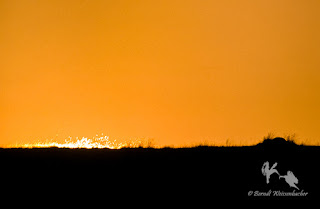
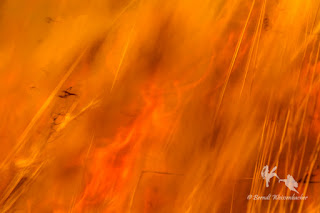
Taller shrubs and trees are generally absent from grasslands. There are several reasons for this absence. The deep and often well-drained soils of grasslands frequently become too dry at deeper levels for tree roots to be able to absorb sufficient moisture. In general, the leaves and smaller twigs of trees and shrubs are also not frost resistant; therefore, taller woody vegetation can not survive the lengthy cold, dry winter seasons. During the winters, fire too becomes a significant ecological factor in grasslands, removing dense old growth from the biome, making nutrients available again for the rapid growth of new grasses during the following growing season. Fire also prevents the encroachment of shrubs and trees into grassland areas.

This image is Copyrighted © Berndt Weissenbacher/BeKaHaWe. If you like it, you may share this image as presented here under a Creative Commons Attribution-NonCommercial-NoDerivs 3.0 License (CC BY-NC-ND 3.0). NO OTHER USE OF THIS IMAGE is permitted without the express consent of the photographer.


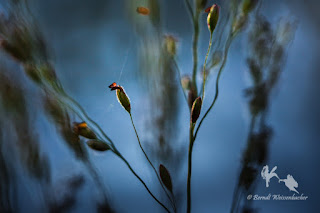
In contrast to most woody vegetation, grasses can survive the challenging conditions of the dry seasons during which grasses become dormant. In winter, the grasses usually die back; that is, the above-ground culms dry out completely while the below-ground root systems survive the harshest of parched cycles. Alternatively, many grasses are annual plants rather than perennials – the adult lives for one season only, during which time the plant germinates from seed, grows rapidly, flowers and sets seed itself, only to die when the dry season commences. As long as the upper soil layer does not become too hot during a fire, the seeds of the previous summer can survive there and the grasslands can persist even through regular cycles of wildfires. The smaller non-woody herbs, flowering plants and the shrubs of the grasslands follow similar strategies.

This image is Copyrighted © Berndt Weissenbacher/BeKaHaWe. If you like it, you may share this image as presented here under a Creative Commons Attribution-NonCommercial-NoDerivs 3.0 License (CC BY-NC-ND 3.0). NO OTHER USE OF THIS IMAGE is permitted without the express consent of the photographer.


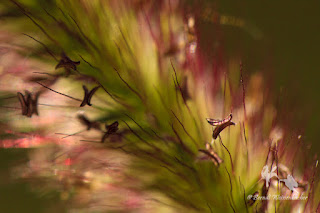
Grasses form a special subset of the vegetable world in many ways. Their roots do not penetrate deep into the soil; rather, the many thin, fibrous roots spread out just under the soil surface, knitting together the top layer of soil. The decomposition of the dead leaves, culms and roots of grasses releases nutrients into the topmost, enmeshed and very fertile soil layer. The web of fibrous roots also captures much soil water before it percolates into the deeper strata following good rains. Sacrificing a long life for rapid growth, grasses with their strap-like leaves and thin culms have done away with thick trunks and large leaves. The strategy employed is one of grow, reproduce and set seed as rapidly as possible. In grasslands, plants that do not produce seeds are very rare.

This image is Copyrighted © Berndt Weissenbacher/BeKaHaWe. If you like it, you may share this image as presented here under a Creative Commons Attribution-NonCommercial-NoDerivs 3.0 License (CC BY-NC-ND 3.0). NO OTHER USE OF THIS IMAGE is permitted without the express consent of the photographer.


Although they are flowering plants, grasses have done away with large, showy flowers. The grasslands, in general, are often too dry for much of the year to support a permanent, large insect population. There exist vast numbers of insects in grasslands, but their appearance in a local area may be unpredictable. Therefore, attracting a pollinator at the correct time – when the flowers have grown and matured, and are ready for pollination and fertilization – is a challenge for any flowering plant in a grassland environment. Instead, grasses have reverted to wind pollination and the flowers have become minute, but bright, splashes of colour in the inflorescences of grasses. Since most grasses grow to a more or less uniform height and the grass stalks are thin, wind can move over and through grasslands relatively unimpeded, except at ground level. Thus wind pollination is an effective strategy for plant reproduction in this environment.


This image is Copyrighted © Berndt Weissenbacher/BeKaHaWe. If you like it, you may share this image as presented here under a Creative Commons Attribution-NonCommercial-NoDerivs 3.0 License (CC BY-NC-ND 3.0). NO OTHER USE OF THIS IMAGE is permitted without the express consent of the photographer.


In contrast to all other plants, the grasses possess a unique feature. In plants that are not grasses, cell division for growth of the organism takes place only in two regions of the plant: at the tips of the roots and twigs (where elongation of all plants takes place), and in woody plants just below the outer covering inside of the bark of larger shrubs and trees (so that an increase in the diameter of roots, trunks and branches can take place). In grasses, however, patches of undifferentiated tissues (the intercalary meristems) occur and cell division can take place at any regular point along the plant. As a consequence, grasses do not stop growing when their leaves and culms are grazed (that is, when the tips of the plants are removed); rather, growth of new plant material will take place from the intercalary meristems. In fact, grasses tend to thrive better if they are grazed to a certain extent. The saliva of the antelopes that graze the grasslands of Africa and elsewhere also stimulates grass growth, an interesting example of co-evolution between a predator and its prey in these two groups that evolved on our planet at the same time.
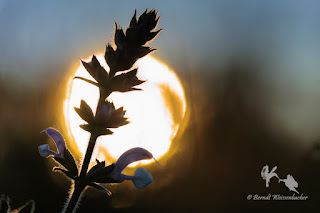

This image is Copyrighted © Berndt Weissenbacher/BeKaHaWe. If you like it, you may share this image as presented here under a Creative Commons Attribution-NonCommercial-NoDerivs 3.0 License (CC BY-NC-ND 3.0). NO OTHER USE OF THIS IMAGE is permitted without the express consent of the photographer.


When people look at grasslands, they may conclude that the biodiversity of this biome is quite low. Grasslands look uniform – there seem to be only grasses present, and these tend to grow to the same length (more or less) in any particular area. However, in South Africa, this biome harbours a tremendously high biodiversity (second only to the fynbos biome of the southern Cape). The grasslands are often home to rare plants, particularly so in the higher-lying areas along the escarpment. These scarce species are often endangered; they comprise mainly endemic geophytes (bulb-producing plants) and dicotyledonous herbaceous plants. However, very few species of grasses are rare or endangered, almost certainly as a result of wind pollination and the production of small seeds.


This image is Copyrighted © Berndt Weissenbacher/BeKaHaWe. If you like it, you may share this image as presented here under a Creative Commons Attribution-NonCommercial-NoDerivs 3.0 License (CC BY-NC-ND 3.0). NO OTHER USE OF THIS IMAGE is permitted without the express consent of the photographer.


All my life I have been a resident of the Highveld of South Africa. My earliest recollections of wilderness are intertwined intimately with the grasslands. As a very young photographer, I often lamented the fact that my family had not lived in a bushveld or coastal area – environments that seemed so much more photogenic in themselves and that appeared to be jam-packed with opportunities of capturing images of wildlife. However, the more I explored, the closer I looked at the grasslands surrounding my home, the more grew my appreciation of the spectacular expanses of the grasslands. Nowadays, I relish the challenge of portraying the grasslands in all their splendour; I cherish every opportunity of arresting, in an image, the fabulous grass menagerie.


This image is Copyrighted © Berndt Weissenbacher/BeKaHaWe. If you like it, you may share this image as presented here under a Creative Commons Attribution-NonCommercial-NoDerivs 3.0 License (CC BY-NC-ND 3.0). NO OTHER USE OF THIS IMAGE is permitted without the express consent of the photographer.