Showing posts with label imagination. Show all posts

Sunday, 4 October 2020

UITTREKSELS UIT: “Wie is Ek?” “Wie is Ons?” – Diere van Afrika Stel vir Jou Raaiseltjies – Reeks 1


Elke reeks bevat veertien kort raaiseltjies. Hulle word aan die jong leser gestel deur ses soogdiersoorte, vyf voëlsoorte, twee ordes insekte en een groep ‘reptiele’. Elke raaisel is geïllustreer met uitstekende fotos. Kom meer te wete oor elke spesie of groep se kenmerkende persoonlikheid, eienskappe en eienaardighede deur te probeer om die vrae te beantwoord “Wie is Ek?” en “Wie is Ons?”.

Om hierdie boekies by jou gunsteling eBoek verskaffer te kan vind, volg die skakel


My Naam is Galago moholi – Wie is Ek?

This image is Copyrighted © Berndt Weissenbacher/BeKaHaWe. If you like it, you may share this image as presented here under a Creative Commons Attribution-NonCommercial-NoDerivs 3.0 License (CC BY-NC-ND 3.0). NO OTHER USE OF THIS IMAGE is permitted without the express consent of the photographer.

Ek is veral beroemd vir my springvermoë – ek klouter nie in bome rond nie, ek wip en spring van tak tot tak, van boom tot boom. Dis hoekom ek 'n lang stert het - my stert help my om my balans te hou. My stert help my ook om koers te hou terwyl ek gedurende 'n lang sprong deur die lug seil. As ek op die grond moet beweeg, omdat die bome te ver van mekaar af staan spring ek ook op my agterbeentjies in lang, hoë boë – jy sal my nooit sien hardloop nie.


My Naam is Struthio camelus – Wie is Ek?

This image is Copyrighted © Berndt Weissenbacher/BeKaHaWe. If you like it, you may share this image as presented here under a Creative Commons Attribution-NonCommercial-NoDerivs 3.0 License (CC BY-NC-ND 3.0). NO OTHER USE OF THIS IMAGE is permitted without the express consent of the photographer.

My ma en pa is die grootste voëls op die hele aardbol. Omdat hulle so groot is kan hulle ongelukkig nie vlieg nie. My ma se vere is van 'n vaalbruin kleur. Net die vere op haar maag en sye is vaalwit. My ma lyk eintlike altyd stowwerig. My pa spog met swart vere op sy rug en vlerke – sy vere op sy maag en sye is spierwit. My pa hou daarvan om sy vlerke wyd te sprei en dan te wikkel; só spog hy met sy veredrag.

Soos jy weet vertel mense graag stories oor die diereryk. Een van dié stories is dat ek sukkel om 'n besluit te neem en dat ek liewers my kop in die sand sal steek as om 'n probleem op te los. Ek kan vir jou nou sê dat ek dit nooit doen nie. Hoekom sou dit in elk geval só wees? Ek is mos baie slim en rats.


Ons is die Dag-aktiewe Skubvlerkige Insekte van die Orde Lepidoptera - Wie is Ons?

This image is Copyrighted © Berndt Weissenbacher/BeKaHaWe. If you like it, you may share this image as presented here under a Creative Commons Attribution-NonCommercial-NoDerivs 3.0 License (CC BY-NC-ND 3.0). NO OTHER USE OF THIS IMAGE is permitted without the express consent of the photographer.

As ons besig is om op 'n blom rond te klouter terwyl ons nektar soek, word ons lywe oortrek met die stuifmeel van blomme. So is ons verantwoordelik vir die bestuiwing en voortplanting van baie plantsoorte. Die blomme self kan nie voortbestaan as ons nie hulle nektar sou drink nie. Dit is hoe ons nog altyd met blomme saamgewerk het – hulle gee vir ons nektar en ons karwei hulle stuifmeel na 'n ander blom toe aan, maar altyd net van een spesifieke blomsoort na dieselfde blomsoort.


My Naam is Equus burchelli – Wie is Ek?

This image is Copyrighted © Berndt Weissenbacher/BeKaHaWe. If you like it, you may share this image as presented here under a Creative Commons Attribution-NonCommercial-NoDerivs 3.0 License (CC BY-NC-ND 3.0). NO OTHER USE OF THIS IMAGE is permitted without the express consent of the photographer.

My lyf is nou nog met langer hare oortrek sodat ek nog 'n bietjie wollerig lyk. As ek ouer word sal my hare kort wees. My lyf is gestreep in wit en swart lyne. As jy mooi oplet sal jy sien dat daar ook dun ligbruin lyne tussen die wit en swart strepe loop. Van my kop af oor my nek tot by my skouers dra ek 'n maan van lang, swart hare wat altyd kiertsregop staan.

Ek het ook 'n lang stert wat met lang, swart hare versier is. Ek gebruik my stert voortdurend om stekende vlieë van my lyf af weg te hou. Mense het altyd geglo dat my strepe vir my 'n soort kamoeflering in die bos is – maar my strepe verwar eintlik die vlieë wat my bloed wil suig sodat ek minder deur dié bloedsuiers gepla word as ander wilde diersoorte.


My Naam is Merops bullockoides – Wie is Ek?

This image is Copyrighted © Berndt Weissenbacher/BeKaHaWe. If you like it, you may share this image as presented here under a Creative Commons Attribution-NonCommercial-NoDerivs 3.0 License (CC BY-NC-ND 3.0). NO OTHER USE OF THIS IMAGE is permitted without the express consent of the photographer.

Noudat ek al baie gesels het, sal jy ook seker wil weet hoe ek lyk en wié ek is. Ek sal eers my ouers beskryf omdat hulle kleurvoller as ek is; jy onthou dat ek nog nie volwasse is nie. Vir voëls is my ouers van middelmatige grote – hulle lywe is redelik lank en slank. Die vere op 'n volwassene se rug en vlerke is 'n mooi, donkergroen kleur. Die vere aan die stert se onderkant is 'n donker blou. Die vere op die bors asook die nekvere en vere op die kop se kruin is van 'n ligte oranjebruin kleur.


My Naam is Phacochoerus aethiopicus – Wie is Ek?

This image is Copyrighted © Berndt Weissenbacher/BeKaHaWe. If you like it, you may share this image as presented here under a Creative Commons Attribution-NonCommercial-NoDerivs 3.0 License (CC BY-NC-ND 3.0). NO OTHER USE OF THIS IMAGE is permitted without the express consent of the photographer.

My stert is lank, dun en kaal, behalwe vir 'n kwas kort hare aan sy punt. My stert word kierts-regop gehou wanneer ek draf; so kan my familie sien waar ek hardloop tussen die lang grasse en struike deur. Só sal my ma haar kinders nie maklik in die bos verloor nie. Dis nou 'n puik sisteem om mekaar te laat weet waarheen jy verdwyn het. Ek is verbaas dat nie meer diersoorte aan hierdie plan gedink het nie.


Ons is die Nie-giftige, Vierpotige Diere Met 'n Skubbige Vel van die Orde Squamata – Wie is Ons?

This image is Copyrighted © Berndt Weissenbacher/BeKaHaWe. If you like it, you may share this image as presented here under a Creative Commons Attribution-NonCommercial-NoDerivs 3.0 License (CC BY-NC-ND 3.0). NO OTHER USE OF THIS IMAGE is permitted without the express consent of the photographer.

Voordat ons met ons raaisel kan begin, moet ons net eers 'n probleem uit die weg ruim. Julle mense het ons nog altyd ‘reptiele’ genoem, maar ons was nog nooit net een natuurlike versameling van diertjies gewees nie. Sommige ‘reptiele’, soos julle aanhou om ons te noem, is nader familie van voëls as wat hulle familie van die ander ‘reptiele’ is.

Dit is eers nóú dat die wetenskaplikes agterkom dat hulle 'n fout gemaak het om ons almal saam in een groot groep te plaas. Ons het glad geen probleem om die voëls saam in ons groep te verwelkom nie – 'n puik en ook wetenskaplik aanvaarbare oplossing! Die voëlkykers sal egter die stuipe kry as hulle agterkom dat hulle nog altyd net ‘reptielkykers’ was. Wié is ons nou eintlik?


My Naam is Haliaeetus vocifer – Wie is Ek?

This image is Copyrighted © Berndt Weissenbacher/BeKaHaWe. If you like it, you may share this image as presented here under a Creative Commons Attribution-NonCommercial-NoDerivs 3.0 License (CC BY-NC-ND 3.0). NO OTHER USE OF THIS IMAGE is permitted without the express consent of the photographer.

Ek het ook aan die begin van hierdie raaisel gesê dat ek wêreldwyd beroemd is. Dis nou nie eintlik ék nie maar wel my ouers. Elke dag patrolleer my pa 'n lang gebied net langs ons rivier om seker te maak dat geen ander voël ons visse daar sal kom vang nie. Jy sal my pa en my ma maklik sien terwyl hulle vir ure op bome sit om ons gebied vir indringers dop te hou. My pa sweef ook gereeld in wye kringe oor sy gebied, of hy vlieg net bo die boomkrone op die rivier se wal rivier-op en rivier-af.


My Naam is Canis mesomelas – Wie is Ek?

This image is Copyrighted © Berndt Weissenbacher/BeKaHaWe. If you like it, you may share this image as presented here under a Creative Commons Attribution-NonCommercial-NoDerivs 3.0 License (CC BY-NC-ND 3.0). NO OTHER USE OF THIS IMAGE is permitted without the express consent of the photographer.

Ek is seker dat jy al 'n storie of wat oor ons gehoor het. Die mense sê aanmekaar dat ons baie slim is, maar dat ons ook slu en agterbaks is. Ek hou glad nie van dié stories nie. Ons is wel slim en boonop is ons baie rats. Ek dink dat daar 'n paar mense is wat dié stories versprei omdat hulle nie so slim en vinnig soos ons is nie.


My Naam is Streptopelia capicola – Wie is Ek?

This image is Copyrighted © Berndt Weissenbacher/BeKaHaWe. If you like it, you may share this image as presented here under a Creative Commons Attribution-NonCommercial-NoDerivs 3.0 License (CC BY-NC-ND 3.0). NO OTHER USE OF THIS IMAGE is permitted without the express consent of the photographer.

Dit is nou al 'n week gelede dat my sussie en ek leer vlieg het. Ek moet bely dat ek nog nie heeltemal die vliegkuns perfek geleer het nie, maar ek kan darem al in goeie, stil weer redelik goed en vinnig vlieg. Ons kinders volg nog heeltyd ons ouers as hulle kos soek – hulle deel ook nog baie van hulle kos met ons. Daar is nog baie om te leer; hoe om in die veld veilig te wees en watter kossoorte waar te vind is. Ek is opgewonde (maar ook 'n bietjie bang) dat ek oor 'n week of so my eie gang sal moet gaan – anders as by jou mag ek nie meer as drie weke by my ouers bly en van hulle afhanklik wees nie.


Ons is die Vinnigvlieënde Jagtende Insekte van die Orde Odonata - Wie is Ons?

This image is Copyrighted © Berndt Weissenbacher/BeKaHaWe. If you like it, you may share this image as presented here under a Creative Commons Attribution-NonCommercial-NoDerivs 3.0 License (CC BY-NC-ND 3.0). NO OTHER USE OF THIS IMAGE is permitted without the express consent of the photographer.

Om die klein prooi wat ons op jag maak te kan raaksien, en om nie in iets vas te vlieg nie, het ons reuse, saamgestelde oë. Dit beteken dat elke oog baie lense het en nie net een soos dit by jou oë die geval is nie. Daarom sien ons enige beweging in die veld om ons maklik raak. Ons oë is só groot dat hulle amper die hele oppervlakte van ons koppe beslaan. Daarenteen het ons nie 'n gooie reuksin nie; ons antennatjies, of te wel voelhorinkies, is maar baie kort. Ons kan ook ons koppe draai omdat hulle deur 'n baie kort nek aan ons borsstukke vasgemaak is. Weereens kan ons die hele wêreld om ons maklik fyn dophou.

Ons is die vinnig vlieënde vername jagters van die waterkante. Om ons te sien moet jy skerp oë hê en jy moet fyn oplet. As jy weer 'n keer by 'n waterbron soos 'n rivier of dam 'n bietjie tyd kan vertoef, kyk uit vir 'n kleurvolle flits wat deur die lug snel. Dít sal een van ons wees!


My Naam is Tragelaphus strepsiceros – Wie is Ek?

This image is Copyrighted © Berndt Weissenbacher/BeKaHaWe. If you like it, you may share this image as presented here under a Creative Commons Attribution-NonCommercial-NoDerivs 3.0 License (CC BY-NC-ND 3.0). NO OTHER USE OF THIS IMAGE is permitted without the express consent of the photographer.

Op my klein koppie spog ek al met twee kort horinkies. My ma lag altyd; sy sê dis nog nie horings nie, dis nou net kort spykertjies. Ek dink sy is 'n bietjie jaloers want sy het nooit horings gehad nie. My pa en ooms spog met die mooiste, lang, gekrulde horings. Hulle lyk soos spirale, 'n bietjie soos die kurktrekker wat jou pa gebruik om 'n wynbottel mee oop te maak. Eendag sal ek ook met 'n paar horings kan spog omdat ek 'n mannetjie is.


My Naam is Alopochen aegyptiaca – Wie is Ek?

This image is Copyrighted © Berndt Weissenbacher/BeKaHaWe. If you like it, you may share this image as presented here under a Creative Commons Attribution-NonCommercial-NoDerivs 3.0 License (CC BY-NC-ND 3.0). NO OTHER USE OF THIS IMAGE is permitted without the express consent of the photographer.

Byna onmiddellik nadat ek en my klein sussies en boeties uit ons eiertjies gebars het, het my ma ons geroep om saam met haar dam toe te stap. Jy sou verbaas gewees het om te sien dat ek só gou kon stap en selfs kon swem – al was dit net dat ek op die water gedobber het en my pootjies gewikkel het om vorentoe te beweeg. My ma en pa het ons veilig gehou – ons het net in 'n klein vlak poeletjie gebly en ons mag nooit ver van die oewer beweeg nie sodat krokodille ons nie kon gaps nie.


My Naam is Panthera pardus – Wie is Ek?

This image is Copyrighted © Berndt Weissenbacher/BeKaHaWe. If you like it, you may share this image as presented here under a Creative Commons Attribution-NonCommercial-NoDerivs 3.0 License (CC BY-NC-ND 3.0). NO OTHER USE OF THIS IMAGE is permitted without the express consent of the photographer.

As jy in die nag slaap is ek wakker en op jag in die pikdonker. Terwyl jy in die skool sit om meer te leer, lê ek lekker in 'n sonkolletjie en rus. As die dag warm raak hou ek daarvan om op 'n breë tak van 'n groot boom te lê en slaap. Jy sal miskien my stert sien afhang – die res van my lyf sal sommer tussen die sonkolle en skaduwees wat op die blare val wegraak.

EXCERPTS FROM: “Who am I?” “Who are We?” – Short Riddles Posed by African Animals – Series 1


Each series contains fourteen short riddles. These are posed to the young reader by six species of mammals, five bird species, two orders of insects and one group of ‘reptiles’. Each riddle is illustrated with superb images. Learn more about each species’ or group’s distinctive personality, characteristics and quirks by attempting to answer the questions “Who am I?” and “Who are We?”.

To find these books at your favourite eBook seller, follow the link


My Name is Galago moholi – Who am I?

This image is Copyrighted © Berndt Weissenbacher/BeKaHaWe. If you like it, you may share this image as presented here under a Creative Commons Attribution-NonCommercial-NoDerivs 3.0 License (CC BY-NC-ND 3.0). NO OTHER USE OF THIS IMAGE is permitted without the express consent of the photographer.

I am especially famous for my jumping abilities – I do not climb about in trees, I skip and jump from branch to branch, from tree to tree. That is why I have a long tail – my tail helps me to keep my balance. My tail also helps me to keep my direction while I am sailing through the air during a particularly long jump. If I have to move along the ground because the trees are growing too far apart from each other, I also jump on my back legs in long, high curves – you will never see me run along the ground.


My Name is Struthio camelus – Who am I?

This image is Copyrighted © Berndt Weissenbacher/BeKaHaWe. If you like it, you may share this image as presented here under a Creative Commons Attribution-NonCommercial-NoDerivs 3.0 License (CC BY-NC-ND 3.0). NO OTHER USE OF THIS IMAGE is permitted without the express consent of the photographer.

My mummy and dad are the largest birds on the entire Earth. Unfortunately, they can not fly because they are so large. My mummy’s feathers are of a dull brown colour. Only the feathers on her belly and flanks are a grubby white. My mummy actually always looks dusty. My dad boasts with black feathers on his back and wings – the feathers on his belly and flanks are pure white. My dad loves to spread his wings out wide and to waggle; in this way he shows off his feather costume.

As you know, people like to tell stories about the animal kingdom. One of these stories is that I struggle to make a decision and that I would rather bury my head in the sand than to solve a problem. I can tell you now that I never do this. Why should this be so in any case? Indeed, I am very clever and nimble.


We are the Day-active Scale-winged Insects of the Order Lepidoptera – Who are We?

This image is Copyrighted © Berndt Weissenbacher/BeKaHaWe. If you like it, you may share this image as presented here under a Creative Commons Attribution-NonCommercial-NoDerivs 3.0 License (CC BY-NC-ND 3.0). NO OTHER USE OF THIS IMAGE is permitted without the express consent of the photographer.

If we are busy clambering about on a flower while we are searching for nectar, our bodies become covered in the pollen of the flowers. Thus we are responsible for the pollination and survival of very many plant species. The flowers themselves could not survive if we would not drink their nectar. This is how we have always still collaborated with flowers – they give us nectar and we carry their pollen to another flower, but always only from one particular species of flower to the same flower kind.


My Name is Equus burchelli – Who am I?

This image is Copyrighted © Berndt Weissenbacher/BeKaHaWe. If you like it, you may share this image as presented here under a Creative Commons Attribution-NonCommercial-NoDerivs 3.0 License (CC BY-NC-ND 3.0). NO OTHER USE OF THIS IMAGE is permitted without the express consent of the photographer.

My body is still covered in longer hairs so that I still look a little woolly. When I get older, my fur will be much shorter. My body is striped with black and white lines. If you look very carefully, you will see that there are also thin light-brown lines between the white and black stripes. From the top of my head, across the top of my neck, up to my shoulders, I carry a dense mane of long, black hairs that always stand up proudly.

I also have a long tail that is decorated with long black hairs. I use my tail constantly to keep biting flies away from my body. Humans always believed that my stripes acted as a sort of camouflage in the bushveld – however, my stripes actually confuse the flies that want to suck my blood. Therefore, these bloodsuckers plague me less than other large game animals.


My Name is Merops bullockoides – Who am I?

This image is Copyrighted © Berndt Weissenbacher/BeKaHaWe. If you like it, you may share this image as presented here under a Creative Commons Attribution-NonCommercial-NoDerivs 3.0 License (CC BY-NC-ND 3.0). NO OTHER USE OF THIS IMAGE is permitted without the express consent of the photographer.

Now that I have chatted a lot already, you will surely also wish to know what I look like and who I am. I will describe my parents first because they are more colourful than I am; you remember that I am not yet an adult. For birds, my parents are of average size – their bodies are quite long and slender. The feathers on an adult’s back and wings are a pretty dark, green colour. The feathers on the underside of the tail or a dark blue. The feathers on the chest, as well as the neck feathers and feathers on the crown of the head, are of a light orange-brown colour.


My Name is Phacochoerus aethiopicus – Who am I?

This image is Copyrighted © Berndt Weissenbacher/BeKaHaWe. If you like it, you may share this image as presented here under a Creative Commons Attribution-NonCommercial-NoDerivs 3.0 License (CC BY-NC-ND 3.0). NO OTHER USE OF THIS IMAGE is permitted without the express consent of the photographer.

My tail is long, thin and naked, except for a bushel of short hairs at its end. When I trot, I hold my tail straight up in the air; in this way, my family can see where I am running to between the tall grasses and shrubs. Thus my mummy will not lose her children easily in the bush. Now this is an excellent way to let each other know whereto you have disappeared. I am surprised that not more animal species have thought up this plan.


We are the Non-poisonous, Four-legged Animals with a Scaly Skin of the Order Squamata – Who are We?

This image is Copyrighted © Berndt Weissenbacher/BeKaHaWe. If you like it, you may share this image as presented here under a Creative Commons Attribution-NonCommercial-NoDerivs 3.0 License (CC BY-NC-ND 3.0). NO OTHER USE OF THIS IMAGE is permitted without the express consent of the photographer.

Before we can begin with our riddle, we just need to clear one problem out of the way. You humans have always called us ‘reptiles’, but we have never been just one natural collection of animals. Some ‘reptiles’, as you continue to call us, are closer family of birds than they are family of the other ‘reptiles’.

It is only now that the scientists realise that they made a mistake by placing all of us together in one big group. We have no difficulty at all in welcoming the birds into our group as well – a superb and scientifically acceptable solution as well! However, the birdwatchers will have a fit when they realise that they have only ever been ‘reptile-watchers’ all of this time! Who are we now actually?


My Name is Haliaeetus vocifer – Who am I?

This image is Copyrighted © Berndt Weissenbacher/BeKaHaWe. If you like it, you may share this image as presented here under a Creative Commons Attribution-NonCommercial-NoDerivs 3.0 License (CC BY-NC-ND 3.0). NO OTHER USE OF THIS IMAGE is permitted without the express consent of the photographer.

I also said at the beginning of this riddle that I am famous the world over. Now, this is not really me, but actually my parents. Every day my dad patrols a long stretch just along our river to make sure that no other bird will come to catch our fish there. You will be able to see my dad and mummy easily while they are perched in trees for hours on end to keep an eye out for invaders in our area. My dad also glides regularly in wide circles over his territory, or he flies just above the treetops along the banks, down-river and up-river.


My Name is Canis mesomelas – Who am I?

This image is Copyrighted © Berndt Weissenbacher/BeKaHaWe. If you like it, you may share this image as presented here under a Creative Commons Attribution-NonCommercial-NoDerivs 3.0 License (CC BY-NC-ND 3.0). NO OTHER USE OF THIS IMAGE is permitted without the express consent of the photographer.

I am certain that you have heard a story or two about us before. Humans say all of the time that we are very intelligent, but also that we are sly and cunning. I do not like these stories at all. We are certainly very intelligent; moreover, we are very nippy. I think that there are some humans who spread these stories because they are not as smart or as nimble as we are.


My Name is Streptopelia capicola – Who am I?

This image is Copyrighted © Berndt Weissenbacher/BeKaHaWe. If you like it, you may share this image as presented here under a Creative Commons Attribution-NonCommercial-NoDerivs 3.0 License (CC BY-NC-ND 3.0). NO OTHER USE OF THIS IMAGE is permitted without the express consent of the photographer.

It is now already a week ago that my sister and I learnt how to fly. I have to confess that I have not yet completely mastered the art of flight perfectly, but I can at least fly quite quickly and well in good, calm weather. We children still always follow our parents as they search for food – they also still share much of their food with us. There is still a lot to learn; about how to be safe in the veld and about what types of food are to be found where. I am thrilled (but also a little bit scared) that I will have to go my own way in a week or so – unlike you, I may not remain with my parents and stay dependent on them for more than three weeks.


We are the Fast-flying Hunting Insects of the Order Odonata – Who are We?

This image is Copyrighted © Berndt Weissenbacher/BeKaHaWe. If you like it, you may share this image as presented here under a Creative Commons Attribution-NonCommercial-NoDerivs 3.0 License (CC BY-NC-ND 3.0). NO OTHER USE OF THIS IMAGE is permitted without the express consent of the photographer.

So that we can see the small prey that we hunt, and so that we do not fly into anything, we have huge, compound eyes. This means that each eye has many lenses and not just the one, as in your eyes. Therefore, we easily see any movement in the veld around us. Our eyes are so large that they take up almost the whole surface of our heads. On the other hand, we do not have a good sense of smell; our antennae, or feelers, are actually very short. We can also turn our heads because they are attached to our thoraces by a very short neck. Again, we can keep careful watch easily over the whole world around us.

We are the fast-flying, formidable hunters of the water’s edges. To see us, you have to have sharp eyes and you must keep watch very carefully. If once again you can linger for a short while at a water source like a river or dam, be on the lookout for a colourful flash that is zooming through the air very speedily. This will be one of us!


My Name is Tragelaphus strepsiceros – Who am I?

This image is Copyrighted © Berndt Weissenbacher/BeKaHaWe. If you like it, you may share this image as presented here under a Creative Commons Attribution-NonCommercial-NoDerivs 3.0 License (CC BY-NC-ND 3.0). NO OTHER USE OF THIS IMAGE is permitted without the express consent of the photographer.

I already sport two short horns on top of my small head. My mummy always laughs; she says these are not horns yet; they are still only short spikes. I think she is a little bit jealous because she never had horns. My dad and uncles brag with the most beautiful, long, twisted horns. They look like spirals, a little bit like the corkscrew your dad uses when he is opening a bottle of wine. One day, I will also be able to show off with a pair of horns because I am a male.


My Name is Alopochen aegyptiaca – Who am I?

This image is Copyrighted © Berndt Weissenbacher/BeKaHaWe. If you like it, you may share this image as presented here under a Creative Commons Attribution-NonCommercial-NoDerivs 3.0 License (CC BY-NC-ND 3.0). NO OTHER USE OF THIS IMAGE is permitted without the express consent of the photographer.

Almost immediately after I and my sisters and brothers had burst out of our eggs, my mummy called us to follow her to the dam. You would have been surprised to see that I could walk so soon and that I could even swim – even if I simply bobbed about on the water and shuffled my feet in order to move forward. Mummy and dad kept us safe – we stayed only in a shallow pool and we were never allowed to move far away from the banks so that crocodiles could not snatch us.


My Name is Panthera pardus – Who am I?

This image is Copyrighted © Berndt Weissenbacher/BeKaHaWe. If you like it, you may share this image as presented here under a Creative Commons Attribution-NonCommercial-NoDerivs 3.0 License (CC BY-NC-ND 3.0). NO OTHER USE OF THIS IMAGE is permitted without the express consent of the photographer.

While you are asleep at night, I am awake and busy hunting in the pitch dark. While you are sitting in school to learn more, I lie pleasantly in a small spot of sunlight and rest. If the day becomes hot, I like to lie down on a broad tree branch and sleep. You might possibly see my tail hanging down – the rest of my body will simply have vanished amongst the patches of sunlight and the shadows falling upon the leaves.

Friday, 21 August 2020

A SENSE OF PLACE: Palmietpan – A Changing Landscape


Every landscape tells its own story; every landscape discloses an ancient history of how it came to be. A history of deposition and erosion, formation and shaping, degradation and re-moulding. A story of the geological processes and the weather that carved and shaped it. The story tells too of recent modifications to those parts of the landscape that are less resistant, more accepting of alteration; at the same time, other parts of the landscape display an unyielding antagonism to change. Whether a landscape’s story is gentle or more violent depends entirely on the specific landscape that is being observed and of its own unique geology and the much more recent history of its occupation (or not) by human beings.


This image is Copyrighted © Berndt Weissenbacher/BeKaHaWe. If you like it, you may share this image as presented here under a Creative Commons Attribution-NonCommercial-NoDerivs 3.0 License (CC BY-NC-ND 3.0). NO OTHER USE OF THIS IMAGE is permitted without the express consent of the photographer.


Is there a single word that expresses “a feeling of place, a sense of place”? The word ‘landscape’ seems wholly inadequate and very restrictive too. In some sense, a landscape describes the lie of the land, the topography of a place. Once captured in an image, a photograph, a sketch or a painting, a landscape acts as a portrait of an area. Like portraits of living beings, the ‘landscape’ we peruse also hints at the character, the unique qualities of a select portion of scenery that enticed the visual artist to record it. At the same time, the ‘landscape’, the portrait of a place, also reveals the personality and sentiment of the visual artist herself; it reveals the emotional response by the artist to a specific location.


This image is Copyrighted © Berndt Weissenbacher/BeKaHaWe. If you like it, you may share this image as presented here under a Creative Commons Attribution-NonCommercial-NoDerivs 3.0 License (CC BY-NC-ND 3.0). NO OTHER USE OF THIS IMAGE is permitted without the express consent of the photographer.


Ever since the start of our relationship, I have been accompanying my wife, Jacqui, on three or four annual trips to an old family farm in the western Free State Province of South Africa. In this part of the interior of the country, the topsoil is sparse and the ground beneath is gravelly at best, if not outright rocky. Unlike the vast, sandy, maize-producing plains to the north-east and east, this part of the Free State is sheep and cattle country. Here the horizon is flat and very distant, broken only by an occasional low ridge or kopje. The sky always dominates the landscape beneath it. On a clear winter’s day, the flat land is overarched by an immensity of deep-blue air; when moisture fills the air during the summer months and thunderstorms construct themselves, the land lies still and silent, as though cowed by the towering cloudscapes above it.


This image is Copyrighted © Berndt Weissenbacher/BeKaHaWe. If you like it, you may share this image as presented here under a Creative Commons Attribution-NonCommercial-NoDerivs 3.0 License (CC BY-NC-ND 3.0). NO OTHER USE OF THIS IMAGE is permitted without the express consent of the photographer.


Along the southern boundary of the family farm lies a sizeable pan – a completely level expanse of salt-encrusted, dark-grey clay. Along its perimeter grow sedges – sometimes (falsely) referred to as palmiet in old Afrikaans. From these two features the farm derives its name: Palmietpan. In the seventeen years that I have been visiting the family farm, I have never seen the pan filled with water.


This image is Copyrighted © Berndt Weissenbacher/BeKaHaWe. If you like it, you may share this image as presented here under a Creative Commons Attribution-NonCommercial-NoDerivs 3.0 License (CC BY-NC-ND 3.0). NO OTHER USE OF THIS IMAGE is permitted without the express consent of the photographer.


On our most recent trip at the end of July 2020, as we approached the farm during the late afternoon, the pan lay before us, glistening. Black-winged Stilts, various species of ducks (including South African Shelduck and Egyptian Geese),
Kittlitz's and Three-banded Plovers, and even a small group of Lesser Flamingos were feeding in different locations and at different depths of water along the shoreline of the pan.


This image is Copyrighted © Berndt Weissenbacher/BeKaHaWe. If you like it, you may share this image as presented here under a Creative Commons Attribution-NonCommercial-NoDerivs 3.0 License (CC BY-NC-ND 3.0). NO OTHER USE OF THIS IMAGE is permitted without the express consent of the photographer.


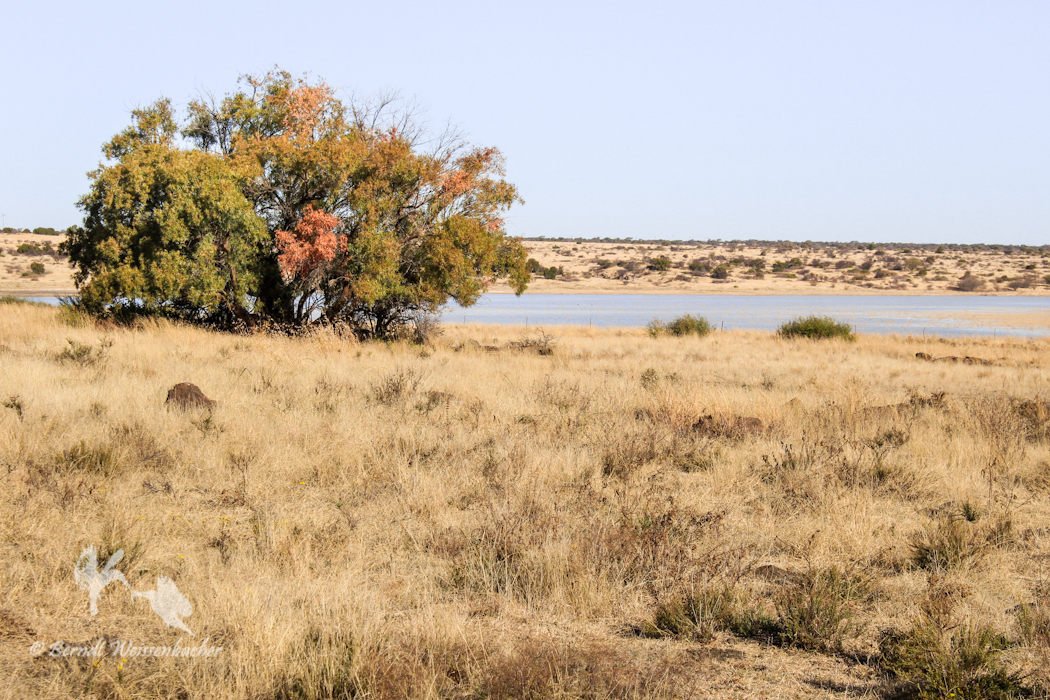
The pan forms a dimple in the otherwise flat countryside of this part of the Free State province. The rim of the pan rises in a very gentle slope from the floor of the pan to the height of the grasslands and thorny scrublands some 100 to 150 metres higher up. Now, at the height of winter, the slope all around the pan was covered in various tall, dry grasses and low thorn scrub, with stunted Sweet Thorn (Acacia (Vachellia) karroo), Buffalo-Thorn Jujube (Ziziphus mucronata), honeythorns (Lycium spp.) and Wild Asparagus (Asparagus laricinus) predominating. On the farm property, on the north-eastern shoreline of the pan, the rim incorporates a small, fairly narrow level step on which stand two groves of very large, ancient Karee (Searsia lancea) trees, now accompanied by scrubby Ziziphus mucronata bushes.


This image is Copyrighted © Berndt Weissenbacher/BeKaHaWe. If you like it, you may share this image as presented here under a Creative Commons Attribution-NonCommercial-NoDerivs 3.0 License (CC BY-NC-ND 3.0). NO OTHER USE OF THIS IMAGE is permitted without the express consent of the photographer.


On this ‘platform’, in the immediate vicinity of these old trees, particularly on sheets of rock exposed by rain and wind, countless San stone artefacts lie scattered about fully exposed. Cutting implements, scraping implements and the occasional arrow tip can be found here. Close-by, a large area of ground is covered in chips and flakes of stone knapped off fist-sized rocks unknown eternities ago.


This image is Copyrighted © Berndt Weissenbacher/BeKaHaWe. If you like it, you may share this image as presented here under a Creative Commons Attribution-NonCommercial-NoDerivs 3.0 License (CC BY-NC-ND 3.0). NO OTHER USE OF THIS IMAGE is permitted without the express consent of the photographer.


This intriguing area has never been studied in detail. Apart from identifying the stone tools as “of San origin”, linked with a comment of “we have sufficient examples of such stone tools”, those South African universities that have been approached with a select sample of the stone implements have not taken any further interest. Yet the landscape of Palmietpan seems to indicate a much more fascinating tale.


This image is Copyrighted © Berndt Weissenbacher/BeKaHaWe. If you like it, you may share this image as presented here under a Creative Commons Attribution-NonCommercial-NoDerivs 3.0 License (CC BY-NC-ND 3.0). NO OTHER USE OF THIS IMAGE is permitted without the express consent of the photographer.


I am not an archaeologist. Any thoughts I express and any claims I may make in this short blog are not grounded in factual evidence. Yet, Palmietpan conveys a kind of ‘sense of place’; it hints at a significance to the San hunter-gatherers in a bygone era. To me, at least, the size of the pan itself, the sheer volume and variety of rock chips and stone tools found in this very small area, and the location of the finds on the only level shelf overlooking the entire pan seem notable. Together, they suggest a far greater import of this site to the aboriginal inhabitants than a mere
happenstance locality fit only for short-lived occupation by a few bands of San at some unknown era in the past.


This image is Copyrighted © Berndt Weissenbacher/BeKaHaWe. If you like it, you may share this image as presented here under a Creative Commons Attribution-NonCommercial-NoDerivs 3.0 License (CC BY-NC-ND 3.0). NO OTHER USE OF THIS IMAGE is permitted without the express consent of the photographer.


The pan is large and, as this winter has proved, it will hold water for months after the last rains have fallen at the end of summer. Alone this possible source of water (albeit unpredictable and seasonal) in a region that experiences long, dry winters would make Palmietpan an area of consequence. The amount of stone chips and flakes that can be found here speak of a site at which the working of stone and the crafting of stone tools took place over a significantly long period of time – to leave such copious evidence behind, work must have taken place here over at least several seasons. Add to this the countless implements found here that were never finished and were simply thrown aside. For a while at least, Palmietpan must have formed part of a stone-crafting workspace. And then the ledge itself adds a definite sense of significance. The view from this only piece of level ground along the rim of the pan covers the entire perimeter of the pan and its surrounding sparse, scrubby thorn-veld. Any animal, any human, moving about in this flat land would have been noticed by a keen observer occupying the level shelf.


This image is Copyrighted © Berndt Weissenbacher/BeKaHaWe. If you like it, you may share this image as presented here under a Creative Commons Attribution-NonCommercial-NoDerivs 3.0 License (CC BY-NC-ND 3.0). NO OTHER USE OF THIS IMAGE is permitted without the express consent of the photographer.


For many days, I have searched the immediate vicinity of the pan relentlessly for a possible source of the rock material used in the knapping process to make these stone implements. A very thin layer of dark-grey, clay-like rock is exposed near the platform with the tree groves. This layer is overlain by several metres of gravel and soil. Yet the incessant excavations of golden moles and the deep tunnel systems mined out of the hard, overlying soil by ground squirrels do hint at a possible source, deep beneath the topsoil, of rock similar to that used long ago by the San for the manufacture of the stone tools.


This image is Copyrighted © Berndt Weissenbacher/BeKaHaWe. If you like it, you may share this image as presented here under a Creative Commons Attribution-NonCommercial-NoDerivs 3.0 License (CC BY-NC-ND 3.0). NO OTHER USE OF THIS IMAGE is permitted without the express consent of the photographer.


At Palmietpan, the landscape is being churned over by these fossorial and burrow-excavating small mammals. Chunks of calcrete and other rock material, not found at the surface, are heaved out of their tunnels by the ground squirrel families. The mounds of the golden moles are littered with stone fragments of precisely the type of rock worked by the San long ago. Beneath the topsoil there must lie further evidence of an occupation, albeit seasonal, of this landscape long ago by a significant number of San artisans.


This image is Copyrighted © Berndt Weissenbacher/BeKaHaWe. If you like it, you may share this image as presented here under a Creative Commons Attribution-NonCommercial-NoDerivs 3.0 License (CC BY-NC-ND 3.0). NO OTHER USE OF THIS IMAGE is permitted without the express consent of the photographer.


For its inhabitants, particularly so for human beings, different landscapes hold different significances. More than that, the same landscape acquires diverse meanings for different individuals too. Different individuals will each react in a singular and personal way to the same landscape. (Each individual human probably can and does envisage or imagine her or his beloved landscape. Often this landscape is part of a precious memory from past travels; sometimes (I suspect in humans other than myself too), this ‘landscape’ is purely imaginary. Each of us probably conveys in the mind her or his own idyllic landscape.)


This image is Copyrighted © Berndt Weissenbacher/BeKaHaWe. If you like it, you may share this image as presented here under a Creative Commons Attribution-NonCommercial-NoDerivs 3.0 License (CC BY-NC-ND 3.0). NO OTHER USE OF THIS IMAGE is permitted without the express consent of the photographer.


A (particular) landscape is often idealised when it is depicted or described. As humans, our penchant for romanticism often imbues a landscape with meaning; it attributes to a landscape a personification and a role that reflects our deepest hopes and desires. The significance of a landscape to us as individuals, families, communities or even nations is often entwined with personal or historical episodes that have shaped our lives: a locality, a landscape, is intimately associated with spaces of personal crisis or of battle, places of hardship or places of plenty, scenes of loss or of gain. We look at landscapes through our own or collective spectacles. We depict our chosen landscapes with these cultural stimuli in mind, so that our view of the land is always emotionally charged and highly subjective. Moreover, for us, the observers, the landscape itself takes on an individuality, a nature that, together with our cultural or private accretions we append to a place, gives rise to an endless and fascinating mythopoeia of landscape.


This image is Copyrighted © Berndt Weissenbacher/BeKaHaWe. If you like it, you may share this image as presented here under a Creative Commons Attribution-NonCommercial-NoDerivs 3.0 License (CC BY-NC-ND 3.0). NO OTHER USE OF THIS IMAGE is permitted without the express consent of the photographer.


So too it is with Palmietpan: the water of the pan, its shorelines of mud and soil, its gentle slopes of thorn-scrub and tall grasses, and its inhabitants over many aeons of time. The landscape of Palmietpan speaks of an oasis, a significant place in the otherwise water-scarce landscape of the western Free State.


This image is Copyrighted © Berndt Weissenbacher/BeKaHaWe. If you like it, you may share this image as presented here under a Creative Commons Attribution-NonCommercial-NoDerivs 3.0 License (CC BY-NC-ND 3.0). NO OTHER USE OF THIS IMAGE is permitted without the express consent of the photographer.


On one of the smaller expanses of exposed rock on the shelf with the two groves of Karee lie the desiccated remains of a long-dead Cattle Egret. This tableau of rock, bone and feathers serves as a reminder to any conscious observer that possession of a landscape and its occupation too are transient indeed. Landscapes seem much longer-lived, and yet, like organisms, they change over time, they age and mature, not only in their geological features, but also in their significances, in their meanings to the current and past inhabitants of the landscapes, in their ‘sense of place’.