Showing posts with label oceans. Show all posts

Thursday, 13 August 2020

VISUAL CONNOTATIONS: I – Of Illusions in the Mind’s ‘Eye’


Ever since early childhood, I have watched clouds. As a photographer, I have added to this predilection the watching of waves, flowing water, patterns in sand, and more. As photographers, we are all essentially searchers for patterns of light.


This image is Copyrighted © Berndt Weissenbacher/BeKaHaWe. If you like it, you may share this image as presented here under a Creative Commons Attribution-NonCommercial-NoDerivs 3.0 License (CC BY-NC-ND 3.0). NO OTHER USE OF THIS IMAGE is permitted without the express consent of the photographer.


All we see is light and nothing but light. Our visual experiences are based entirely on the reception of reflected, refracted, dispersed, diffracted light. The only addition to the sensation of vision is twofold. Firstly, analysis and interpretation by our visual cortex in the brain takes place of the impulses delivered from our retinal cells in the eyes by nerves. Then, possible ‘editing’ by our imagination follows this. We do not see a tree in front of us; we simply perceive light that has bounced off an object that absorbs some wavelengths of sunlight and not others, scatters some wavelengths but not all. Our mind, however, pretends that the object is actually there, that it is in reality what it seems to us – that is, a real, genuine tree and not a meaningless simulacrum or a figment of our imagination.


This image is Copyrighted © Berndt Weissenbacher/BeKaHaWe. If you like it, you may share this image as presented here under a Creative Commons Attribution-NonCommercial-NoDerivs 3.0 License (CC BY-NC-ND 3.0). NO OTHER USE OF THIS IMAGE is permitted without the express consent of the photographer.


Our mind can do nothing else; for without this interpretation by our visual system that some of the patterns of light that we perceive indicate the presence of real objects (important as food, predators, shelter, for example), sight as an adapted sense could not have evolved. However, should we ever be able to interrogate a different species about what it sees, the answer we receive would astound us.


This image is Copyrighted © Berndt Weissenbacher/BeKaHaWe. If you like it, you may share this image as presented here under a Creative Commons Attribution-NonCommercial-NoDerivs 3.0 License (CC BY-NC-ND 3.0). NO OTHER USE OF THIS IMAGE is permitted without the express consent of the photographer.


And so, from the very beginning, all sensations, not only sight, were limited to the perception of the stimuli provided by the patterns of the world and not the processes, the emergent patterns only resulting from underlying formative processes that are hinted at but that remain elusive. We humans are obsessed with pattern, in particular the diversity of patterns. For us, a miniscule difference between two otherwise matching patterns is imbued inevitably with interest, with importance; distinctions always indicate a significance for which we want to ‘know’ the reason. Identical patters too are significant because they represent another food item, another predator or another mate, for example. Our minds focus on difference and similarity.


This image is Copyrighted © Berndt Weissenbacher/BeKaHaWe. If you like it, you may share this image as presented here under a Creative Commons Attribution-NonCommercial-NoDerivs 3.0 License (CC BY-NC-ND 3.0). NO OTHER USE OF THIS IMAGE is permitted without the express consent of the photographer.


Our attempts to set boundaries and to classify our experiences of the world around us probably are as ancient as the advent of our nervous systems, certainly as old as the advent of language. Just as ancient as language as well are our problems with our classification systems – if something fits here, it necessarily does not belong there – and thus the struggle begins to shoehorn objects, concepts and experiences into rigid frameworks of classification, usually arranged hierarchically to reflect some more of our mind’s biases. Alternatively, we hack liberally at existing categories, cleaving away ever-smaller pockets to house our favoured items, and so populating our classifications with sub-, meta- and hyper-taxa. Consequently, our perception of the world has become categorised into discrete entities, and we have lost the ability to perceive the fundamental unity of process that has shaped every pattern that we can sense in our surrounding.


This image is Copyrighted © Berndt Weissenbacher/BeKaHaWe. If you like it, you may share this image as presented here under a Creative Commons Attribution-NonCommercial-NoDerivs 3.0 License (CC BY-NC-ND 3.0). NO OTHER USE OF THIS IMAGE is permitted without the express consent of the photographer.


Of course, this endeavour of classification does not end with the inanimate and animate world, but extends, by use and habit, into our own human existence and into our relationships with other humans. Since we focus intensely on the distinctions between patterns, we are often convinced that the boundaries we imagine and construct in our minds and knowledge are real; they are a true representation of hiatuses in reality, even in otherwise continuous patterns and processes. From there, it becomes almost inevitable that we should set and reinforce with significance the boundaries that we believe will be of help to us while we attempt to keep our own group safe and separate from the barbarians at the gate.


This image is Copyrighted © Berndt Weissenbacher/BeKaHaWe. If you like it, you may share this image as presented here under a Creative Commons Attribution-NonCommercial-NoDerivs 3.0 License (CC BY-NC-ND 3.0). NO OTHER USE OF THIS IMAGE is permitted without the express consent of the photographer.


So, two quirks of our mind and our experiences, the hiatus between reality and our sensory experience of it and our mind’s obsession with pattern and boundaries, amalgamate with devastating outcome to limit our knowledge and imagination. It is the confusion and conflation of process and pattern that can and does befuddle our minds. Simple and well-known illustrations of our minds’ predispositions are optical illusions of various kinds.


Illusions, in general, are defined as instances of the perception and interpretation of sensory experiences that give rise to misrepresentations of reality – instances during which the experience differs from actuality. Illusions are not faults of our sensory systems; they indicate the physical and biological restraints of our systems and of our cognitive interpretation of the sensory stimulation received.


This image is Copyrighted © Berndt Weissenbacher/BeKaHaWe. If you like it, you may share this image as presented here under a Creative Commons Attribution-NonCommercial-NoDerivs 3.0 License (CC BY-NC-ND 3.0). NO OTHER USE OF THIS IMAGE is permitted without the express consent of the photographer.


Optical illusions are a subset of sensory illusions; they are illusions arising from the workings of our visual system. Some so-called optical illusions are not really illusions as defined since they do not lead to misrepresentations of reality. Examples include the ‘bending’ of the straw as you immerse it in a glass of water, and the fact that ‘in reality’ the sun is already located beneath the horizon while you can still see it above the horizon at sunset.


This image is Copyrighted © Berndt Weissenbacher/BeKaHaWe. If you like it, you may share this image as presented here under a Creative Commons Attribution-NonCommercial-NoDerivs 3.0 License (CC BY-NC-ND 3.0). NO OTHER USE OF THIS IMAGE is permitted without the express consent of the photographer.


These physical optical ‘illusions’ are really optical phenomena that arise when light is refracted as it travels across the boundary between media of differing optical densities. These are ‘strange’ realities and not faults of the visual system or a result of misinterpretation by our minds. The less strange optical phenomena like the dispersion of light in rainbows or halos do not qualify as optical illusions at all; yet in the process of the interaction of light with matter there is no significant difference between these less peculiar observations and instances of the ‘illusions’ of the refraction of light.


This image is Copyrighted © Berndt Weissenbacher/BeKaHaWe. If you like it, you may share this image as presented here under a Creative Commons Attribution-NonCommercial-NoDerivs 3.0 License (CC BY-NC-ND 3.0). NO OTHER USE OF THIS IMAGE is permitted without the express consent of the photographer.


The fascinating, often mesmerising, misrepresentations of reality, the truly illusory visual experiences, are the result of ambiguities that arise in the processing and interpretation of the visual information received by the brain. These ambiguities are often triggered by unconscious assumptions and inferences of what the information ‘pictures’.


This image is Copyrighted © Berndt Weissenbacher/BeKaHaWe. If you like it, you may share this image as presented here under a Creative Commons Attribution-NonCommercial-NoDerivs 3.0 License (CC BY-NC-ND 3.0). NO OTHER USE OF THIS IMAGE is permitted without the express consent of the photographer.


In the second instalment, I will explore further the illusions our minds experience or conjure up, and the implications that the human mind’s phenomenal ability at pattern recognition (and misrecognition) hold for the visual arts, including the craft of photography.


Tuesday, 16 June 2020

ABOUT THIS IMAGE... ‘Rock Cod'


I am certain that I am not alone in my frustration over the current lockdown restrictions on movement of individuals and travel imposed by the majority of governments worldwide in response to the COVID-19 (SARS-CoV-2) pandemic. As these restrictions have been extended over months, my own opportunities as a photographer have been limited severely.


This image is Copyrighted © Berndt Weissenbacher/BeKaHaWe. If you like it, you may share this image as presented here under a Creative Commons Attribution-NonCommercial-NoDerivs 3.0 License (CC BY-NC-ND 3.0). NO OTHER USE OF THIS IMAGE is permitted without the express consent of the photographer.


If I were informed by government that I would have to spend the rest of my life ‘isolated’ on a particular tiny patch of this planet’s surface (an area of 50 metres by 50 metres, say), what kind of environment would be ideal for photography? Shut away from all others and never again being able to leave my assigned space, I would hope that my new, restricted homeland would be situated somewhere along the shoreline.

I am besotted with the bushveld of Africa and spend most of my photographic opportunities in some manifestation of this veld-type. However, square metre for square metre, the shoreline (a stretch of rocky shore with a slither of sandy beach thrown into the mix) beats any other wilderness environment hands down in terms of photographic opportunities in a small, restricted area.


This image is Copyrighted © Berndt Weissenbacher/BeKaHaWe. If you like it, you may share this image as presented here under a Creative Commons Attribution-NonCommercial-NoDerivs 3.0 License (CC BY-NC-ND 3.0). NO OTHER USE OF THIS IMAGE is permitted without the express consent of the photographer.


I have had only very few opportunities to visit the coast (for various reasons that are of no importance here). On the rare occasions that I have been privileged to take photographs in this environment, I have worked myself to exhaustion. The variety of line, shape, texture, pattern, rhythm and colour that is on show here and available to a photographer to compose into wonderful images is endless. So too is the variety of subjects: from the ceaseless to-and-fro movement of wave and surf (quiet, gentle and caressing at one moment, thundering, overpowering and abusive the next), to the exotic, intoxicating miniature gardens of the rock-pools and the constant scuttling about and hide-and-seek of crabs and other denizens of rock and sand.

A long time ago, in pre-digital days, I spent my first ever week and a half of stills photography along a very short strip of rocky shore in Scottburgh (KwaZulu-Natal Province, South Africa). Only a single railway line and a low dune separated the house that a work colleague had provided as accommodation for this trip from the rocky shore. Each day I combed the same strip of coast thoroughly and intimately from before sunrise to well after sunset, stopping only during the hottest midday hours.


This image is Copyrighted © Berndt Weissenbacher/BeKaHaWe. If you like it, you may share this image as presented here under a Creative Commons Attribution-NonCommercial-NoDerivs 3.0 License (CC BY-NC-ND 3.0). NO OTHER USE OF THIS IMAGE is permitted without the express consent of the photographer.


By the end of an exhilarating, yet exhausting, first week, I was convinced that I had visited and explored every square metre of this strip of rocky shore. Most certainly, I knew intimately the path through the rocks from and to the gap in the tangled vegetation of the dune that I had to cross to get to the rocky shore or to the house that I was occupying. After all, by now I had trudged along this path four times a day for a full week.

And yet, on the second last day of my sojourn, quite late in the morning, on my way ‘home’, I stumbled across a flat sheet of rock covered in the most intriguing lines. Immediately, the outline of a cubist cartoon of a ‘fossilised’ fish popped into view. I must have crissed and crossed over, walked on, looked at and inspected this small, flat slab several times during the previous week without ‘seeing’ the potential that this ‘rockscape’ offered, the unique and splendid arrangement of lines, shapes and textures.


This image is Copyrighted © Berndt Weissenbacher/BeKaHaWe. If you like it, you may share this image as presented here under a Creative Commons Attribution-NonCommercial-NoDerivs 3.0 License (CC BY-NC-ND 3.0). NO OTHER USE OF THIS IMAGE is permitted without the express consent of the photographer.


Here it had lain, my ‘Rock Cod’, exposed to sun and surf, not for a week, but for years certainly. This experience has taught me to look, look and look again. To ‘see’ and capture an image that excites me requires not only the subject matter itself, but also a conjunction of the subject, my mood, my imagination and my vision.

Tuesday, 12 May 2020

THE WORLD OF WATER: A PERSONAL JOURNEY – Part II: The Ocean and its Waves

For any alien traveller, Earth would be a beacon in the vastness of space. Of all the planetary bodies in our solar system, the blue marble we live on is the only one with liquid water covering most of its surface. It is common cause amongst biologists that the presence of liquid water is a sign for the possible existence of life on any planet in the universe. Therefore, to a traveller through space Earth stands out as a likely home for the organic complexity we call life.


This image is Copyrighted © Berndt Weissenbacher/BeKaHaWe. If you like it, you may share this image as presented here under a Creative Commons Attribution-NonCommercial-NoDerivs 3.0 License (CC BY-NC-ND 3.0). NO OTHER USE OF THIS IMAGE is permitted without the express consent of the photographer.


Water covers over 70% of Earth’s surface, an expanse of approximately 361 million square kilometres. With an average depth of between three to four kilometres, the single ocean of our planet holds about 1, 34 billion cubic kilometres of water. So, a watery world indeed, but salty too. The ocean that comprises over 97% of Earth’s water has accumulated dissolved minerals throughout its more than four billion-year existence, so that of seawater’s mass today 3, 5% is made up of dissolved salts and other minerals.


This image is Copyrighted © Berndt Weissenbacher/BeKaHaWe. If you like it, you may share this image as presented here under a Creative Commons Attribution-NonCommercial-NoDerivs 3.0 License (CC BY-NC-ND 3.0). NO OTHER USE OF THIS IMAGE is permitted without the express consent of the photographer.


Our planet’s single ocean forms over 90% of the biosphere, that thin, tenuous layer of the Earth’s surface that can sustain life. It is no surprise then that the ocean is home to more than 93% of all presumed life-forms on our planet. Presumed living species that is, because we have hardly bothered to explore this vast realm, most of which exists in complete darkness – sunlight can not penetrate seawater to a depth greater than a hundred metres or so. It is an indictment to the often-misguided human endeavour that we know less about our ocean than we know about the moon or the surface of Mars; we have explored only around 6% of this immense and vitally important region of our own home.


This image is Copyrighted © Berndt Weissenbacher/BeKaHaWe. If you like it, you may share this image as presented here under a Creative Commons Attribution-NonCommercial-NoDerivs 3.0 License (CC BY-NC-ND 3.0). NO OTHER USE OF THIS IMAGE is permitted without the express consent of the photographer.


We owe our existence to the ocean. The first organisms, the first living beings, evolved in seawater between 3, 5 and 4 billion years ago. These are our ancestors. Since the evolution of photosynthesis, first be cyanobacteria and much later by algae, the surface waters illuminated by sunlight made available the production and release of oxygen into the atmosphere as a waste product of this process. For aeons algae have absorbed vast amounts of carbon dioxide from the atmosphere, thereby mitigating (up until recently in Earth’s history, that is) the accumulation of heat by the planet.


This image is Copyrighted © Berndt Weissenbacher/BeKaHaWe. If you like it, you may share this image as presented here under a Creative Commons Attribution-NonCommercial-NoDerivs 3.0 License (CC BY-NC-ND 3.0). NO OTHER USE OF THIS IMAGE is permitted without the express consent of the photographer.


The majority of sunlight striking exactly half of the Earth’s surface at any moment in time irradiates the ocean. As the ocean surface heats up, currents and transfer of heat to the atmosphere redistribute this energy, driving the planet’s climate systems and thus doling out precipitation around the globe. Like a gigantic conveyor belt of energy, the ocean helps regulate Earth’s land temperatures, acting as coolant in summer and heater in winter. Without this global re-distribution of heat, surface temperatures on land would be unbearable for the substantial majority of terrestrial organisms.


This image is Copyrighted © Berndt Weissenbacher/BeKaHaWe. If you like it, you may share this image as presented here under a Creative Commons Attribution-NonCommercial-NoDerivs 3.0 License (CC BY-NC-ND 3.0). NO OTHER USE OF THIS IMAGE is permitted without the express consent of the photographer.


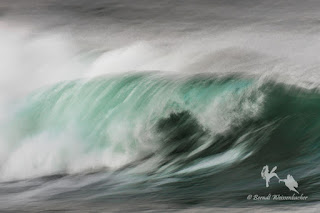
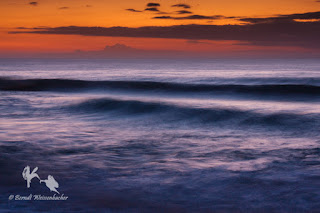
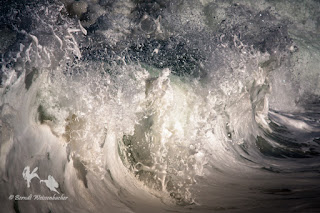
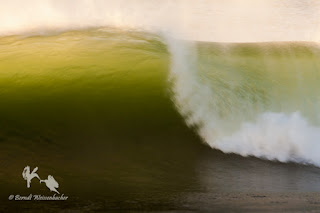
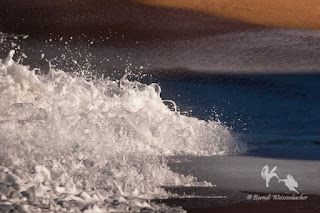
Other than the fathomless immensity of the ocean, the most spectacular feature of this underappreciated waterworld are its waves. As the ocean is ruffled by the nudging and shuddering of the dynamic rocky planet on which it rests, and as it is whipped by winds of its own making, the surface water undulates. These wrinkles travel over the expanse of the ocean, the upper water column bobbing up and down as it is lifted into crests and dropped into troughs. When the undulations reach shallower water at the margins of islands and continents, as though wishing to greet the land first, the crests bend forward as a result simply of the deeper water slowing down as it rubs and scours over the ocean floor in these shallow zones.


This image is Copyrighted © Berndt Weissenbacher/BeKaHaWe. If you like it, you may share this image as presented here under a Creative Commons Attribution-NonCommercial-NoDerivs 3.0 License (CC BY-NC-ND 3.0). NO OTHER USE OF THIS IMAGE is permitted without the express consent of the photographer.


For me personally, waves represent a myriad of marvels. The process of wave action is well understood scientifically; it is a continual process and relatively simple in mechanism. Yet each wave is unique. The encounter of each wave while ‘wave-watching’ is unique too. The experience ranges from perception of the susurrations of gentle wavelets lapping at sandy beaches to the thunderous cacophony of invincible titans assaulting the very continents themselves. Depending on the time of day, the quality of sunlight, the mood of the tides, and the weather, my experiences and the concomitant thoughts and emotions provoked by the watching of waves flit from tranquil bliss to atavistic fear. And all the while the waves remind me of my own, very special history on Earth: from my ocean-borne ancestors billions of years ago to my present insignificance on this unique planet, Earth.


This image is Copyrighted © Berndt Weissenbacher/BeKaHaWe. If you like it, you may share this image as presented here under a Creative Commons Attribution-NonCommercial-NoDerivs 3.0 License (CC BY-NC-ND 3.0). NO OTHER USE OF THIS IMAGE is permitted without the express consent of the photographer.

Sunday, 10 May 2020

THE WORLD OF WATER: A PERSONAL JOURNEY - Part I: Introduction

As I near rapidly the completion of my sixth decade of tenure on our Earth, I feel more and more compelled towards introspection: to make sense of what has happened, what I have experienced and how I have reacted to such experiences. Of course, my own journey represents only an infinitesimal fraction of the experiences of all members of a particular and peculiar species, Homo sapiens – never mind the experiences of millions of other species that have been and are inhabitants of this singular planet.


My own personal reminiscences represent at best a wisp of time, a miniscule crumb of place – nostalgias that are so insignificant as to make thinking or writing about them seem supremely self-important. Yet, there remains this compulsion deep within me, to ponder, to think, to express and to share these recollections. I do not believe that this is arrogance: if anything, I stand humbled and in complete awe of the universe as a whole, and particularly of this planet I may call home and its myriad denizens.

This image is Copyrighted © Berndt Weissenbacher/BeKaHaWe. If you like it, you may share this image as presented here under a Creative Commons Attribution-NonCommercial-NoDerivs 3.0 License (CC BY-NC-ND 3.0). NO OTHER USE OF THIS IMAGE is permitted without the express consent of the photographer.

I was very privileged to grow up in a house on the edge of a suburb. Looking out from my bedroom window, I was faced, not by a neighbour’s dwelling with tended lawns and flowerbeds, but by a sizeable patch of South African veld. ‘Veld’ has various meanings in southern Africa: it can refer to bushveld (savannah) or to grassland; it can incorporate kopjes (boulder-strewn hills) or rante (rocky ridges); it can be undulating or flat. It did not matter to me at all what kind of veld I was playing in or trudging through as a child; the veld became my spiritual home at a very young age.

This image is Copyrighted © Berndt Weissenbacher/BeKaHaWe. If you like it, you may share this image as presented here under a Creative Commons Attribution-NonCommercial-NoDerivs 3.0 License (CC BY-NC-ND 3.0). NO OTHER USE OF THIS IMAGE is permitted without the express consent of the photographer.

South Africa is a water-poor part of the African continent. Where I grew up on the Highveld (a vast plateau in the interior of the country covered in grassland), the winters were dry – up to five months of clear blue skies with no rain at all. Brown, dusty, fire-prone grasslands. When, as kids, we did stumble across water of any kind, our delight was expressed fully: mud-fights in shallow pans, crab-hunting along rivulets, or bathing in deep, rocky pools on a hot summer day were all part of childhood and early adolescence.

This image is Copyrighted © Berndt Weissenbacher/BeKaHaWe. If you like it, you may share this image as presented here under a Creative Commons Attribution-NonCommercial-NoDerivs 3.0 License (CC BY-NC-ND 3.0). NO OTHER USE OF THIS IMAGE is permitted without the express consent of the photographer.

The contrast between the veld in all its facets and the watery worlds made an impression on me from very early on. The world of water was fluid; the veld was solid. The colour palette of the veld was striking and beautiful, but it paled when compared to the ever-changing palette of the world of water. In this rare world on the Highveld, the liquid world, there was flow – swift movement and rapid observable changes when compared to the terrestrial realm.

This image is Copyrighted © Berndt Weissenbacher/BeKaHaWe. If you like it, you may share this image as presented here under a Creative Commons Attribution-NonCommercial-NoDerivs 3.0 License (CC BY-NC-ND 3.0). NO OTHER USE OF THIS IMAGE is permitted without the express consent of the photographer.

Thus my fascination with two worlds in particular: the African veld and its inhabitants, and the world of water in all of its forms – rain, mist, ponds, pans, rivers and oceans, and clouds too.

This image is Copyrighted © Berndt Weissenbacher/BeKaHaWe. If you like it, you may share this image as presented here under a Creative Commons Attribution-NonCommercial-NoDerivs 3.0 License (CC BY-NC-ND 3.0). NO OTHER USE OF THIS IMAGE is permitted without the express consent of the photographer.

In the next four instalments of this series, I will be looking a little more closely at this most magnificent World of Water.

This image is Copyrighted © Berndt Weissenbacher/BeKaHaWe. If you like it, you may share this image as presented here under a Creative Commons Attribution-NonCommercial-NoDerivs 3.0 License (CC BY-NC-ND 3.0). NO OTHER USE OF THIS IMAGE is permitted without the express consent of the photographer.